

The waiting (for 2026) game
4 December 2025RISK INSIGHTS • 10 December 2025
Kevin Hassett: A Potential Shift in Federal Reserve Leadership

Harun Thilak, Head of Global Capital Markets NA
In the evolving landscape of the U.S. administration’s economic policy, Kevin Allen Hassett has emerged as a frontrunner to succeed Jerome Powell as Chair of the Federal Reserve. With the administration signalling an early 2026 nomination for the Fed Chair, Hassett's potential appointment points to a more dovish tilt that could reshape monetary policy amid ongoing debates over inflation, growth and interest rates. A seasoned economist with deep ties to conservative think tanks and the current administration, Hassett would bring a blend of academic rigor and political experience to the role, while eschewing an ultra dovish policy bias.
Background
Hassett's background is rooted in academia and public service. He holds a Ph.D. in economics from the University of Pennsylvania and a B.A. from Swarthmore College. He held academic positions, including as an associate professor of economics and finance at Columbia University's Graduate School of Business from 1989 to 1994. Early in his career (1992-1997), he served as a senior economist at the Federal Reserve Board of Governors, providing him with direct insight into central banking operations.
From 1997, Hassett spent significant time at the American Enterprise Institute (AEI), a conservative think tank, where he was primarily involved in commandeering various economic policy studies. He chaired the Council of Economic Advisers (CEA) from 2017 to 2019, advocating for tax cuts and deregulation to spur growth. Currently, he serves as Director of the National Economic Council, positioning him as a key advisor on domestic economic matters.
Policy stance: an “ultra dove”?
Hassett's recent rhetoric reflects optimism about the U.S. economy while critiquing current Fed policy. He has emphasized robust growth and low unemployment, arguing that inflation risks are overstated and that the economy can handle looser monetary conditions. In recent interviews, he has called for immediate interest rate cuts, predicting a 25-basis-point reduction at the Fed's December meeting and advocating for rates to trend much lower over time to support expansion.
This ultra dovish bias contrasts with Powell's cautious approach. Hassett has suggested aggressive easing to align with the current adminstration’s pro-growth agenda, potentially prioritizing stimulus over inflation control. Critics worry this could erode Fed independence, with likely Hassett likely to face resistance from Federal Open Market Committee (FOMC) members if he pushes for cuts beyond what the data justify.
His statements have fuelled speculation of a precipitous fall in policy rates, which could potentially spur rallies in risk assets such as equities and cryptocurrencies in the short term, but raise concerns about spiralling inflation and Fed independence in the long term - ultimately proving detrimental to confidence in US assets.
Path to the Fed
The Fed Chair nomination process is a constitutional exercise in checks and balances. The President nominates the candidate, who must be confirmed by the Senate as both a Board Governor (for a 14-year term) and Chair (for a four-year term). The Senate Banking Committee first reviews qualifications through hearings, then votes to advance the nominee to the full Senate for majority approval. This scrutiny is designed to safeguard independence, though partisan dynamics could accelerate Hassett's confirmation given Republican control.
Powell's term ends in May 2026, but the administration is aiming for a swift transition.
Market reaction to the potential nomination
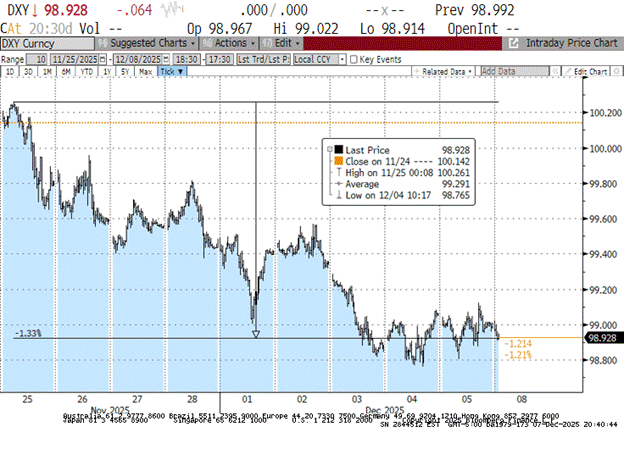
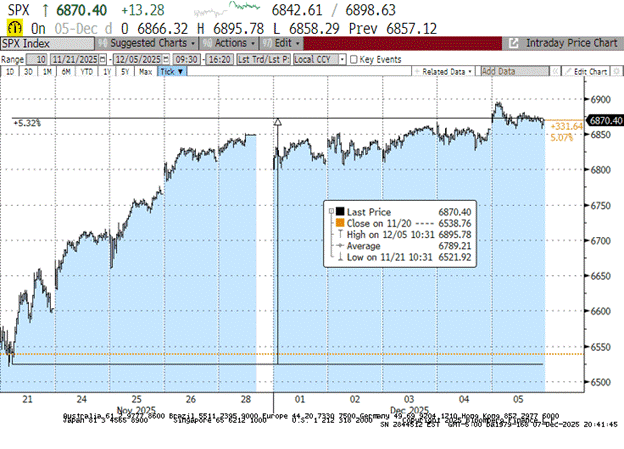
Since news of Hassett's likely nomination surfaced in late November 2025, markets have shown mixed reactions. Equities have rallied on expectations of prolonged easing, with the S&P 500 climbing as investors anticipate lower rates boosting growth. Bond markets, however, have been spooked: the 10-year Treasury yield rose amid fears that aggressive cuts could fuel inflation or undermine Fed credibility, which has also contributed to a weaker USD.
Overall, while stocks view Hassett as bullish at least in the short-term, bonds and USD reflect caution over potential volatility, even as prediction markets peg the odds of his nomination at around 75%.
In conclusion, Hassett's nomination could herald a more accommodative Fed and foster short-term market gains, but risk long-term stability if it is perceived as politicized. As confirmation looms, investors will need to watch closely for signals on economic resilience and the durability of market reaction.
Chart 1: Bloomberg USD index USD index USD index
Source: Bloomberg
Chart 2: US 10Y yields since late November
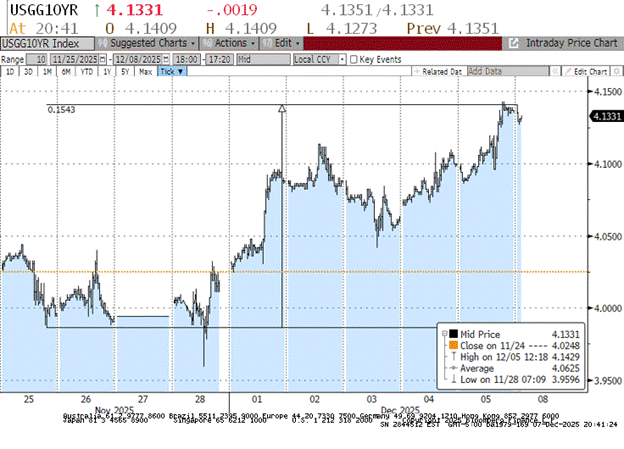
Chart 3: S&P 500 index since late November
Source: Bloomberg