

Ep 4: 2026 Market Outlook: What Matters for Private Capital
25 February 2026
Validus named Risk Management Software Provider of the Year at the Private Equity Wire European Awards 2026
26 February 2026RISK INSIGHTS
Tariffs Overturned: US Supreme Court Clips Executive Power
By Validus | 25 February 2026 | 5 min read

Harun Thilak, Head of Global Capital Markets NA
After months of careful deliberation, on February 20, 2026, the U.S. Supreme Court (SCOTUS) delivered a pivotal ruling, striking down the US President’s sweeping tariffs imposed under the International Emergency Economic Powers Act (IEEPA). In a 6-3 decision authored by Chief Justice John Roberts, the Court held that IEEPA does not authorize the President to impose tariffs, as this power constitutes taxation - a domain exclusively vested in Congress under Article I, Section 8 of the Constitution. The tariffs in question, enacted shortly after the President’s second inauguration in 2025, targeted drug influxes from Canada, Mexico, and China (with rates up to 25%), and "reciprocal" duties on imports from all trading partners (starting at 10%, escalating for dozens of nations). These measures, justified as responses to national emergencies like public health crises and trade deficits, were deemed illegal by SCOTUS, lacking explicit congressional delegation for unbounded tariffs in scope, amount, or duration. The ruling invalidated tariffs that had collected over $130 billion in 2025, opening the door to potential refunds estimated at up to $175 billion, although the Supreme Court left exact refund processes to be finalized by the lower courts. This decision marked a rare judicial check on the President and executive trade authority, emphasizing that Congress must act clearly when delegating such economically significant powers.
Key takeaways:
- The US Supreme Court has ruled the US President’s tariff regime illegal, marking a rare judicial check on his authority.
- While the US President lambasted the decision, he responded swiftly and raised the global statutory tariff rate to 15%, and invoked a series of constitutional statutes.
- USD has continued to slide in response, accentuating the downward trend seen for the past year. Sustained uncertainty could spike yield curves and widen credit spreads.
- Moving forward, given opposition to the President’s tariff regime from both Democrats and Republicans, Congressional approval could prove tricky.
A New Statutory Playbook
The US President lambasted the ruling while swiftly pivoting to alternative legal avenues within his purview. Hours after the decision, he announced a 10% global tariff under Section 122 of the Trade Act of 1974, effective February 24, 2026, citing a "large and serious" balance-of-payments deficit. The next day, February 21, he escalated it to 15% - the statutory maximum - via executive order, claiming it would counteract nations "ripping off" the U.S. Unlike IEEPA's open-ended authority, Section 122 limits tariffs to 150 days without congressional extension, making this a temporary measure potentially expiring by July 2026. The President also signaled plans to invoke other statutes, such as Section 232 for national security and Section 301 for unfair practices, reinstating elements of the struck-down regime. This defiance underscores the President’s commitment to protectionism, but it injects fresh uncertainty into global trade, as allies like the UK and EU express alarm over potential violations of existing deals.
Nuances of Presidential Powers and Restrictions on Global Tariffs
The Constitution grants Congress sole authority over tariffs as a form of taxation and regulation of foreign commerce. Presidents lack inherent peacetime power to impose them, relying instead on delegated statutes with built-in constraints.
Section 232 allows tariffs on imports threatening national security, but requires Commerce Department investigations and faces judicial scrutiny for misuse.
Section 301 targets unfair trade practices, permitting retaliatory duties after USTR probes, though limited to addressing specific harms.
Section 122, now in play, addresses balance-of-payments issues with a 15% cap and 150-day sunset, necessitating congressional buy-in for longevity - unlikely amid midterm elections. Lesser-known tools like Section 338 of the 1930 Tariff Act could counter discrimination, authorizing up to 50% duties. However, the Court stressed that delegations must be explicit, with procedural safeguards like time limits and investigations, preventing "transformative expansions" of executive power. Without congressional approval, Presidents cannot enact permanent, universal tariffs, highlighting separation-of-powers tensions.
Dollar Drag
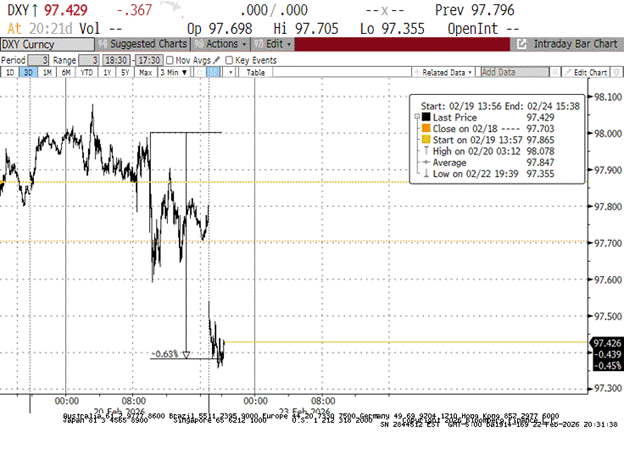
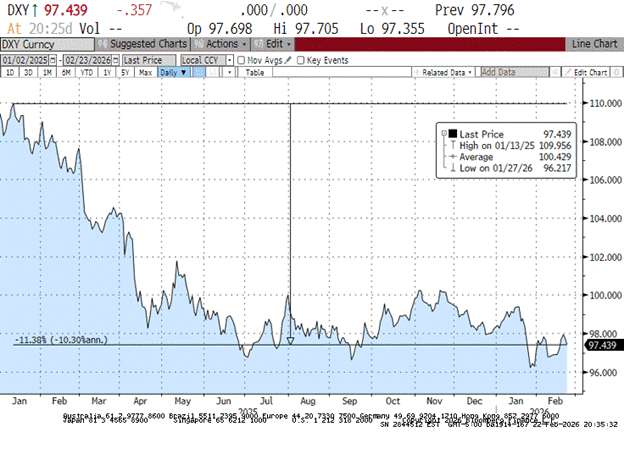
USD has faced the initial brunt following the SCOTUS ruling, with the DXY index currently down about 65 basis points since the decision. This reaction accentuates the downward trend seen in the USD throughout the President’s second term, with the DXY falling by ~11% since January 2025. Prolonged uncertainty could steepen US yield curves, widen credit spreads and divert capital from US assets, thereby pressuring the USD further.
Chart 1: DXY post Supreme Court decision
Source: Bloomberg
Chart 2: DXY since Jan 2025
Source: Bloomberg
Looking Ahead: Expectations for U.S. Trade Policy
Moving forward, the President’s tariff agenda faces significant headwinds.
With many Democrats and even certain Republican leaders in Congress opposed to his tariff plans, obtaining Congressional approval as a path forward could prove to be tricky for the Administration.
The 15% Section 122 tariffs expire mid-2026 without congressional extension, prompting likely shifts to targeted Section 232/301 actions, although legal challenges loom. The 2026 United States-Mexico-Canada Agreement (USMCA) review could reshape North American trade, emphasizing zero tariffs for energy and predictability. Expect more exemptions and bilateral deals as partners retaliate and seek clarity on existing and ongoing trade negotiations. Broader reforms may emerge, prioritizing resilience over disruption, but executive discretion will sustain uncertainty, weighing on growth and inflation.