

Validus Advises Arcmont on its $2.5bn Continuation Vehicle
21 May 2026RISK INSIGHTS
Eurozone in Flux: Energy, Inflation and the ECB’s Pivot
By Validus | 28 May 2026 | 5 min read

Harun Thilak, Head of Global Capital Markets NA
Key takeaways:
- The Eurozone entered 2026 with moderate resilience, but growth momentum is now slowing
- A renewed energy shock has pushed headline inflation higher, complicating the earlier disinflation narrative
- The ECB has shifted from an easing bias to a more cautious, data-dependent stance markets assess the risk of rate hikes
- For investors, the outlook points to a stronger euro, firmer yields and greater sensitivity to geopolitical and inflation risks
Despite demonstrating moderate resilience through 2025, the Eurozone economy, like most others, is facing renewed headwinds in 2026.
Full-year 2025 GDP growth reached approximately 1.4%, outperforming some initial expectations and supported by stabilizing inflation, robust labor markets and domestic demand. However, quarterly figures reveal a moderate deceleration: GDP expanded by around 0.3% quarter-on-quarter in Q4 2025 before slowing to around 0.1 - 0.2% in Q1 2026.
Country-level divergences are notable. Spain continued as a standout performer with strong growth, while Germany showed some resilience. France stagnated, and Italy trended closer to its structural pace.
Unemployment remains a bright spot, hovering near historic lows around 6.1 - 6.3% in early 2026, reflecting a still-tight labor market despite cooling employment growth. This supports household balance sheets and private consumption, though consumer confidence has weakened amid broader uncertainties.
Inflation Rebound Driven by Energy Shock
A key development in 2026 has been the resurgence of inflationary pressures.
After fluctuating between roughly 1.9% and 2.5% in 2025 and approaching the ECB’s 2% target, headline inflation (HICP) rose to 2.6% in March 2026 and reached 3.1% in April. Energy prices surged due to geopolitical tensions in the Middle East, driving annual energy inflation sharply higher. Core inflation (excluding food and energy) has remained more contained around 2.2%.
Forecasts for 2026 inflation have been revised significantly upward, with certain projections now centering around 3.0% amid persistent energy and potential food supply chain disruptions, representing a notable departure from earlier disinflation expectations.
Middle East Conflict Prompts Revised Outlook
The primary external shock has been the escalation of hostilities in the Middle East, disrupting oil and liquefied natural gas flows and triggering an energy price spike. This has compounded existing challenges, including higher US tariffs on EU exports (particularly autos) and global trade policy uncertainty.
These developments have introduced downside risks to growth and upside risks to inflation, creating a stagflation-like environment that complicates policymaking. Geopolitical tensions have also weighed on confidence and export competitiveness.
ECB: From Easing to Vigilance
The European Central Bank responded to improving conditions in 2025 with rate cuts, lowering the deposit facility rate to 2.00% by mid-2025. Policy has since remained on hold through early 2026 meetings, including March, as the Governing Council assesses the evolving outlook.
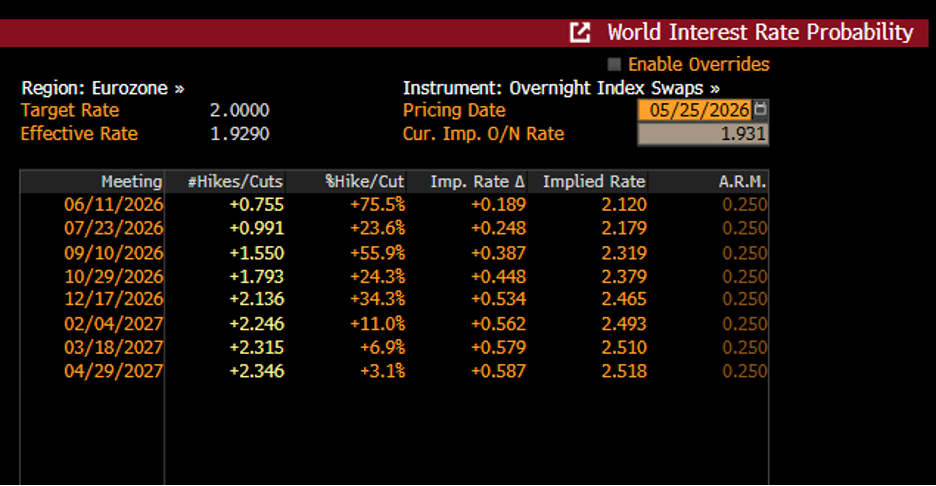
In response to the energy-driven inflation rebound, markets have priced in potential hikes, with speculation around a possible 25 basis point increase as early as June 2026 alongside 50 basis points of hikes priced in for 2026.
ECB communications emphasize a data-dependent, meeting-by-meeting approach without pre-commitment to any path. Projections have been adjusted: growth forecasts lowered, while inflation outlooks were revised higher, particularly for 2026.
The ECB views current policy as broadly calibrated but stands ready to address second-round effects if energy costs feed more broadly into wages and prices. Longer-term inflation expectations remain anchored near 2%, though short-term measures show some upward drift.
Chart 1: Chart 1: Eurozone policy rate trajectory implied from OIS markets
Source: Bloomberg
EURUSD Finds Support
ECB policy divergence with the Federal Reserve - holding or modestly tightening while the Fed continues easing - supports a relatively stronger euro. The interest rate differential has narrowed but remains a factor favoring EUR strength if the ECB avoids deep cuts. A stronger euro may help dampen imported inflation but could pressure export competitiveness.
For broader interest rates, ECB caution implies eurozone bond yields may stabilize or edge higher in response to inflation risks and potential hikes; influencing mortgage rates, corporate borrowing and investment. A stronger currency and stable-to-higher rates could support euro-denominated assets but temper growth in trade-exposed sectors.
A Look Ahead: Risks and Stability
The Eurozone faces a complex environment of subdued growth, resurgent inflation from external shocks, and a vigilant but data-driven ECB.
Policy is likely to remain restrictive or neutral in the near term to safeguard the 2% target, with implications rippling through currency markets and borrowing costs. Success hinges on containing second-round effects, navigating geopolitics and leveraging labor market strength.
Thus, while risks are currently elevated, the underlying resilience of private balance sheets and targeted public investment offer cautious grounds for optimism looking towards 2027.