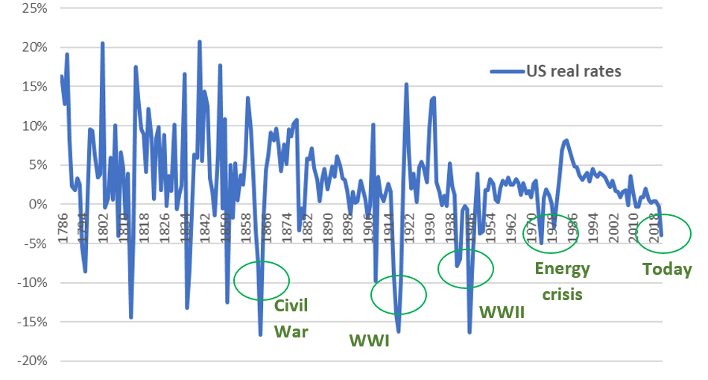
As market participants put Jackson Hole behind them and celebrate Chair Powell’s conciliatory speech, by driving of equity markets to new all-time highs, the key question is whether the observed inflation is transitory as viewed by Chair Powell. We are at a crucial decision point, with two paths ahead: A) continued accommodative policy in the face of rising inflation which, if proves not to be transitory, may lead to untamed inflation, and B) reducing accommodative policy which encompasses the risk of torpedoing the economic recovery.
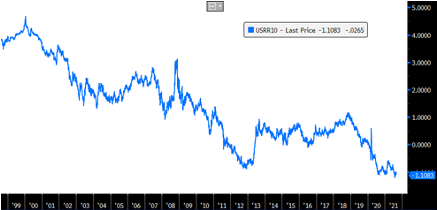
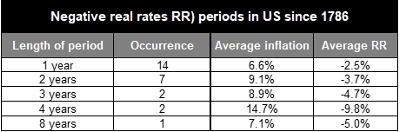
In low interest rate regimes, such as what we witness today, higher inflation can mean negative real interest rates (RR). With 10-year US Treasuries presently at 1.30% and 10-year inflation expectations of 2.4%, the owner of a 10-year bond would expect their investment to “erode” (in terms of purchasing power) by 1.1% per year.
Negative RR have a wide range of consequences, among others: as bonds become less attractive, savers are de-incentivized and the search for returns will direct inflows into riskier assets of all types, lifting their prices, some would argue, way past their fair valuation. Other consequences might not be known yet.