

How Geopolitical Risks Are Splitting Central Bank Policy
25 March 2026
What GPs Need to Know: Managing Open-Ended Funds
9 April 2026RISK INSIGHTS
Supply Shock: The Price of Infrastructure Destruction
By Validus | 7 April 2026 | 5 min read

Kambiz Kazemi, Chief Investment Officer
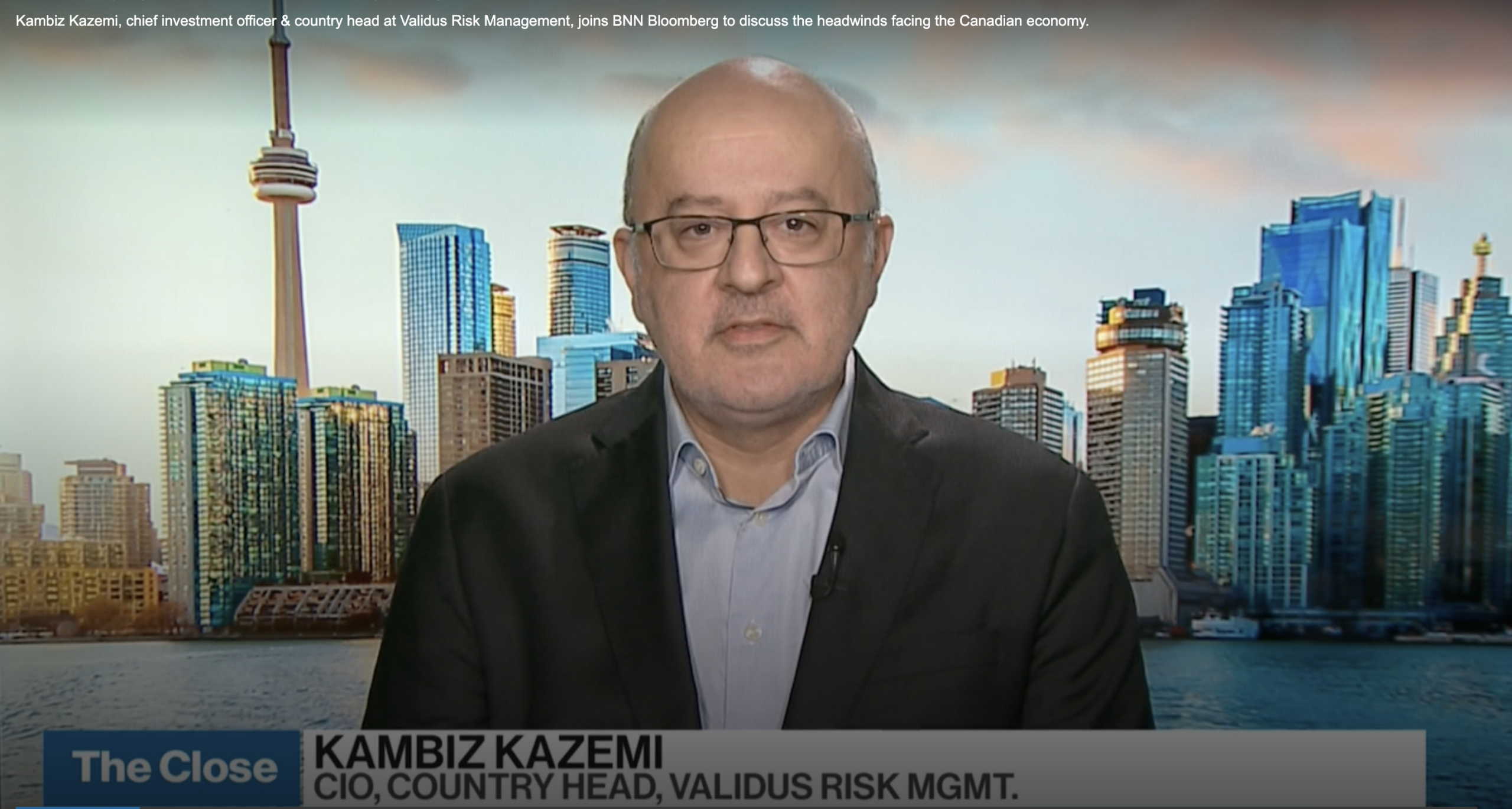
Kambiz Kazemi was recently featured on BNN Bloomberg to discuss the headwinds facing the Canadian economy.
Watch the clip below for additional insights.
Key takeaways:
- Markets and asset prices do not appear to reflect the extent and depth of the Middle East conflict’s risks
- The Covid crisis provides a useful framework to analyze what may lie ahead. The difference is that this time, ramifications of supply destruction are likely to be far more acute, damaging and long-lasting
- In light of this possible outcome, unprepared portfolios and positioning could lead to an abrupt repricing across a wide range of risk assets
As the U.S. Administration’s deadline to reopen the Strait of Hormuz approaches, financial markets and asset prices do not appear to reflect the extent and depth of the difficult period facing the global economy.
Nearly 40 days into the war, markets appear to have taken some comfort from the U.S. Administration’s relatively successful attempts to stabilize oil prices through the lifting of sanctions on Russia and Iran (as paradoxical as that may seem). Additionally, there is a desensitization due to the never-ending reel of turbulent headlines.
If the US administration, delivers on its threats to strike Iran’s power grid, bridges and other civilian infrastructure it is all but certain that Iran will, to the extent its military resources permit, respond in kind by attacking the infrastructure of the Gulf countries.
The ramifications of such a scenario could be far-reaching and deeply concerning.
Covid as a framework for understanding the next shock
The Covid crisis provides a useful framework for analyzing what may lie ahead now, as its impact was felt most keenly with:
- Supply disruption: supply either came to a halt or was drastically curtailed due to lockdowns and pandemic-related workspace policies
- Transportation disruption: logistics and transport networks experienced surges in demand and were also impacted by health restrictions
Together, these factors created backlogs and delays, which in turn helped drive post-pandemic inflation, the effects of which are still being felt today.
Supply shock: From disruption to destruction
Where Covid resulted in a supply disruption, infrastructure wars would result in supply destruction.
The Middle East is not only a major producer of oil (30%) and gas (18%), but also urea - a key component of fertilizers (30%) - as well as helium (35%), aluminum (10%) and sulfur (45%).
Unlike Covid, the destruction of supply in these core commodities and chemicals would create a long-term deficit. Infrastructures such as refineries, factories, and petrochemical facilities would take years to rebuild. Even if such facilities are not directly or heavily targeted, and attacks are limited to electrical grids, the damage could still take years to repair. In turn, the lack of reliable power would leave many of these installations and factories operating at sharply reduced capacity.
Transmission effect across the global economy
One can imagine the acute rise in prices of these materials, and the inflationary impact that would follow. More importantly, in the absence of alternative production sources, the entire industrial chains that depend on them would be affected as well.
The consequences would reach across sectors- including healthcare and semiconductors (which rely on helium), transport (which is dependent on fuel) and agriculture (through its reliance on fertilizer), as well as a vast web of interdependent industrial outputs.
This scenario would act as an echo chamber for inflationary pressures. It would also likely trigger competition for scarce resources, similar to the scramble by different countries for Covid vaccines, bringing with it a new set of geopolitical effects and complications.
Transportation disruption and chokepoints that matter
The disruption of traffic through the Strait of Hormuz is, in fact, at the heart of the U.S. Administration’s latest threats. Any escalation into infrastructure warfare would prolong that disruption, but there is a real risk that alternative routes- such as the Bab-Al-Mandab Strait- could also be closed to navigation if the Houthis of Yemen choose to threaten or enforce a closure. That would further paralyze global transport and, again, amplify inflationary pressures in an already strained environment.
The world holds out hope for de-escalation and for the developments described above to be avoided. However, markets and investors do not appear to have fully priced in the repercussions of such a scenario. As a result, portfolios and positions may face an abrupt repricing across a wide range of risk assets.