Source: Bloomberg
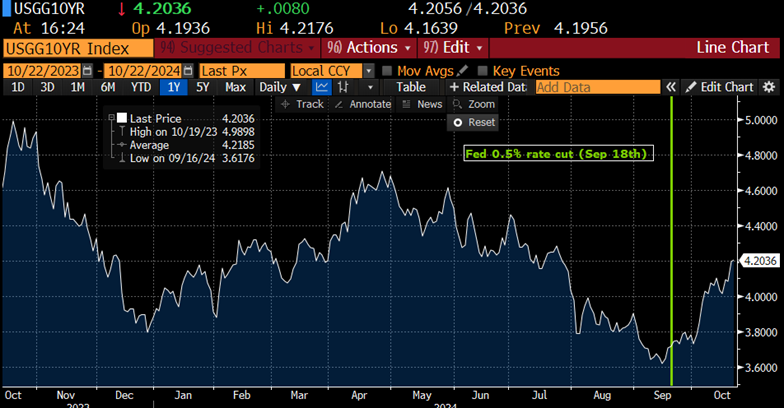
Historically, lower overnight rates and expectations, or the actual start, of the cutting cycle have typically been accompanied by a drop in rates across the yield curve.
Yet, despite an important initial rate cut and continued expectations for further easing – albeit less acute – into the end of 2025, long-term interest rates have risen over the last month.
What could be behind this rise of the long end of the yield curve? Is it a signal for what might be coming, or is it a symptom of existing forces? Let’s explore some potential explanations.
1. Slower and lesser (rate cuts)
Recent economic data, particularly the robust September unemployment figures, have generally been healthy and surprised the markets to the upside. The risk of a recession has all but evaporated, and a soft landing now seems to be the likely worst case scenario for analysts and pundits.
As a result, the market has adjusted its path of rate cuts. While rate cuts are still expected to continue through the end of 2025, the projected terminal rate has been roved up to 4.10% from 3.5% a month ago.
As such, part of the adjustment in long term rate expectations can undoubtedly be explained with this correction in short term rates.
2. Debt and fiscal uncertainty
The recent joint statement by the US Treasury and the Office of Management and Budget (OMB) highlighted the continued trend of higher debt and deteriorating fiscal health. With the debt to GDP ratio surpassing 120%, reaching record levels not seen since post World War II, concerns are mounting.
While the US government’s balance sheet and ability to service its debt has historically been unquestioned, the lack of clear commitment from politicians or either possible incoming administration to tackle the issue at its core seems to be starting to instill the seeds of doubt.
Fiscal austerity is a word markets have not heard in a long time, and both candidates’ proposed policies appear to be driving further deficits, potentially exacerbating the national debt.
Under such conditions, compounded by a higher cost of servicing the debt due to higher interest rates, it is unsurprising that bond bears and vigilantes are coming out of hiding.
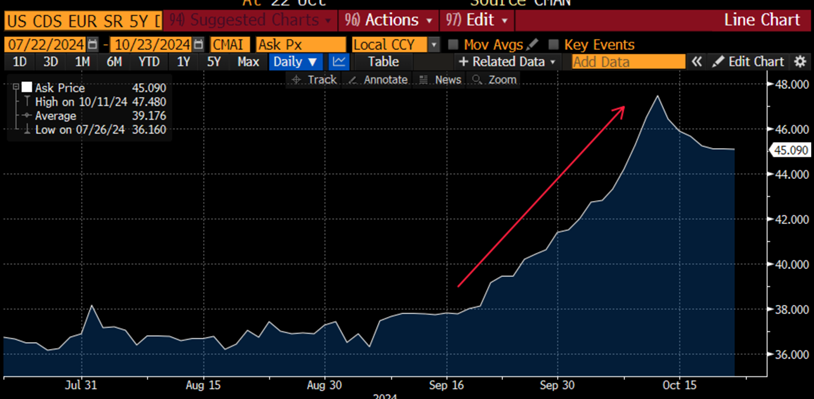
A closer look at the 5-year Credit Default Swaps for US Treasuries – which measures the cost of insuring against a default of US Treasuries – confirms our hunch, having risen by 25% to 0.46% in the last month and half. This means it costs 0.46$ per year to insure against a default of US Government on $100 of its debt, up from 0.35$ in early September.
While this figure remains low and is far from prohibitive, it is significantly above the 0.18$ average from 2014 to 2022.
Chart 2: 5-Year Credit Default Swap (CDS) for US Treasuries