Why Now? Diversification, Geopolitics, Inflation
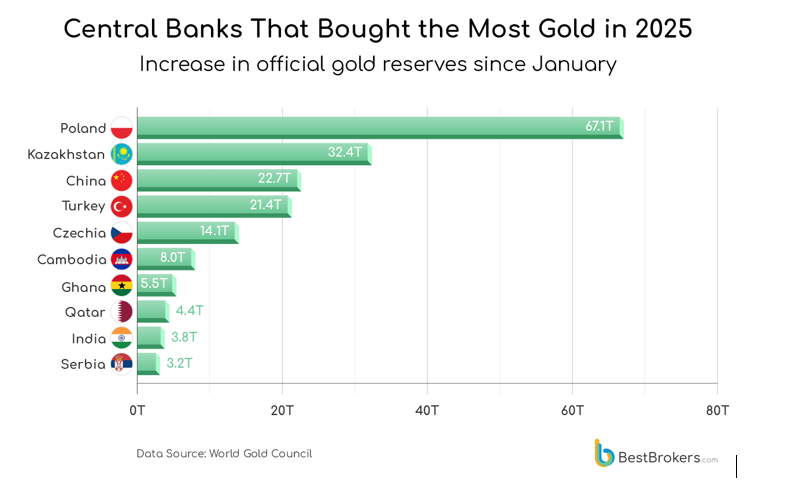
As for the causes of this frenzy, the usual explanations are in play: a desire by CBs to diversify away from the US dollar as a reserve, the geopolitical uncertainty (for instance, justifying the aggressive buying by Poland given its proximity to the Russia-Ukraine conflict), and concerns around a potential cyclical resurgence of inflation.
In our view, the data undoubtedly supports the idea that many decision-makers are looking to diversify reserves away from the USD, in particular:
- The World Gold Council survey of 71 central Banks (Q2 2025) indicated that 73% of respondents expected the share of the USD in their reserves to decrease over the next 5 years, while 76% expected the share of gold reserves to increase.
- The data in unequivocal: by August 2025, for the first time since 1996, the share of US Treasuries held as reserves by central banks (ex-US) had dropped below that of gold reserves – 23% versus 24%, respectively.
- Furthermore, 81% of respondents cited inflation concerns as the second most relevant reason for their reserve management decisions, just after interest rates, which were cited by 93% of them.
A clear picture emerges: the traditional arguments for holding gold – which were absent or weakened for the better part of four decades – are resurgent and top of mind for investors across the spectrum.
Momentum begets momentum
We therefore see this trend to have a high potential of being sustained by a positive feedback loop and the late bloomers who will join the fray.
This, in turn, can have important ramifications. Gold remains a physical commodity and production has its limits (projected at approximately 3,200 tonnes in 2025), and proven reserves are finite. Therefore, scarcity can become relevant – especially as CB demand is complemented by financial instruments backed by it.
It is no surprise that we have seen a lift-off in prices of other precious metals as investors become more aware of the sector and the intricacies of the physical versus financial markets. The price of silver has made a new 43-year high and is up nearly 30% since early September.
We expect a high probability that the tide lifts other precious metals such as palladium and platinum, as investors see relative underperformance.
For those who find comfort in statistics and history: the highest appreciation of the price of gold in a 21-month period (106% presently) post-Bretton-Woods (1971) was nearly 300% in 1976-1980 – admittedly a period marked by tremendous levels of inflation. History might not repeat itself, but it does seem to rhyme.