

Why Washington Joined Japan’s Yen Intervention

Why Washington joined Japan’s Yen intervention

21 August 2026

Key Takeaways

  • Coordinated US-Japan intervention may have been aimed not only at supporting the yen, but also at reducing the risk that Japan would need to sell large amounts of US Treasuries to fund further action
  • Despite record-scale intervention, USDJPY recovered part of its initial move, underlining how difficult it is to reverse yen weakness while underlying rate and capital-flow dynamics remain unchanged
  • The yen’s medium-term outlook will depend heavily on the US–Japan rate differential, global risk sentiment and whether Japanese capital begins to move back onshore.
  • For fund managers, sudden yen strength can create sharp negative mark-to-market moves on FX forwards and potentially significant short-term collateral requirements, making stress testing increasingly important

On 29 July, a hawkish Fed hold pushed 30-year Treasury yields to 5.21%, the highest level since 2007. The following day, Japan’s Ministry of Finance began its largest currency intervention in 15 years. By Friday, the US Treasury had joined it. While the true magnitude may not be known for some time, estimates of Japan’s intervention range from $80 billion to more than $100 billion over a three-day period.

US monetary authorities last intervened in the yen in 2011 – albeit to weaken it after Fukushima – and before that in 1998. So why take such an unusual step now?

The US administration’s recent statement that “we’re always there for Japan” suggests the US was simply helping an ally defend a currency at 40-year lows. But another explanation has a more self-interested slant; i.e., that Washington was also seeking to protect its own bond market.

Washington’s Motive: Protecting the Long End

Japan holds roughly $1.2 trillion in foreign exchange reserves, with the bulk held in US Treasuries. However, only around $200 billion is held in cash or cash equivalents. That distinction matters for Washington. If Japan continues to intervene in the spot market, it could eventually need to liquidate part of its Treasury holdings to raise the dollars required to fund further intervention.

That is the potential supply shock Treasury Secretary Scott Bessent would likely prefer to avoid, particularly with long-term Treasury yields already elevated.

Three observations support this motive:

The pattern of participation. Japan signaled intervention in January without following through, intervened alone in April, and then intervened on a record scale in July with US support. Long-end Treasury volatility was elevated in January and July, but calmer in April. This could suggest that US participation was influenced partly by a desire to limit additional pressure on domestic borrowing costs.

The scale. US participation in coordinated intervention has historically been around $1–2 billion, compared with an estimated Japanese leg of approximately $85 billion in this episode. If the primary US objective had been to control the spot exchange rate directly, a larger intervention might have been expected. Instead, the relatively small US contribution may have been intended to strengthen the credibility of Japan’s intervention by demonstrating political backing from Washington.

The push on FIMA. Secretary Bessent has publicly advocated expanding the Fed’s FIMA facility, which allows foreign central banks to borrow US dollars through repo transactions collateralized by US Treasuries. For Japan, greater access to this facility could provide substantial dollar liquidity without requiring authorities to sell Treasuries into the secondary market, reducing the risk of a supply-driven rise in US yields.

Scale and Effect: Record Firepower, Ordinary Result

It is estimated that the Ministry of Finance spent around $85 billion on 30 and 31 July, marking its largest two-day intervention on record outside the 2011 Fukushima response. USDJPY fell roughly 3%. The much smaller US leg was followed by a further 2% decline.

Yet record-sized intervention produced a relatively ordinary currency move. USDJPY subsequently recovered around 2.65% from its post-intervention low of 155.23, reflecting the fact that the structural forces that have driven yen weakness for years remain largely unchanged.

USDJPY Spot Moves Post Joint US-Japanese Intervention
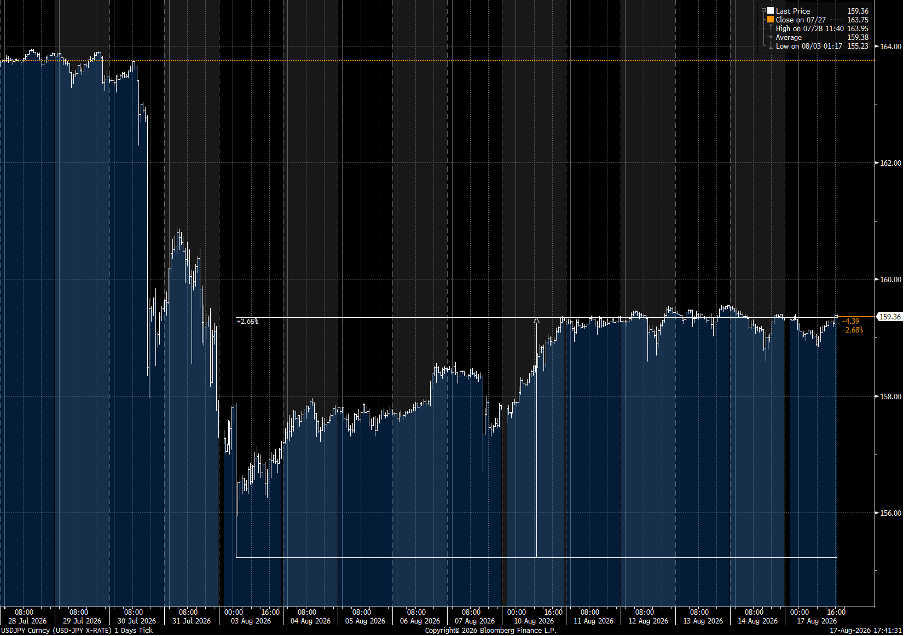
The intervention was not a complete failure for Japan. For now, USDJPY remains below the levels seen before the operation, while the signaling effect of coordinated US-Japan action could provide more persistent support than a unilateral intervention. That may buy Japanese authorities time to adjust policy and address some of the structural pressures weighing on the currency.

For the US, however, the outcome has been less encouraging from a bond-market perspective. Long-end auctions on 12 and 13 August cleared at historically high yields: the 10-year stopped at 4.683%, its highest level since 2007, while the 30-year cleared at 5.216%, its highest since 2001.

Structural Pressures on the Yen Remain

We see three key factors that could drive medium- to long-term yen performance. Beyond the immediate market reaction, currency intervention alone is unlikely to offset these underlying forces.

Higher JPY Rates. Markets are already pricing a 73% chance of a September hike, with around 40 basis points of tightening priced by year-end. However, the latest Q2 GDP print was softer than forecast, at +1.1% quarter-on-quarter annualized versus +2.0% expected, which could make it more difficult for the BOJ to tighten aggressively. US rates have not fallen substantially either, as inflation risks remain elevated amid the Iran conflict. If the US-Japan rate differential does not narrow materially, investors have less incentive to unwind existing carry trades or refrain from establishing new ones.

Global growth or AI-confidence shock. The yen typically operates as a safe-haven asset, meaning a deterioration in global growth or a sharp correction in risk assets could prompt renewed demand for the currency.

Repatriation of capital. A significant structural driver of Yen weakness is the continuous outflow of domestic savings, as Japanese investors seek stronger returns overseas. While real JGB yields at some maturities have turned positive in recent years, this has so far done little to reverse the broader flow of capital abroad.

What Comes Next for the Yen?

The next BoJ decision looms large: with a hike largely priced in, any further increases may provide only limited additional support for the yen. By contrast, a hold could reinforce existing concerns around the rate differential and trigger renewed JPY weakness.

Markets also remain wary of further intervention. Front-end skew in options markets suggests investors are still cautious about another operation pushing USDJPY lower, while Japan retains substantial capacity to act again.

The timing of any further intervention may also be influenced by US data releases rather than Japanese developments alone. The most effective operation of the 2024 cycle coincided with a weaker-than-expected US CPI print, suggesting Tokyo may be more inclined to intervene when market conditions are already supportive of yen appreciation.

For risk managers, the implication is clear. Further sudden declines in USDJPY or EURJPY could generate sharp negative mark-to-market moves for EUR- and USD-based fund managers hedging JPY exposures with FX forwards. With both monetary policy and intervention risk capable of moving the currency quickly, firms should proactively analyze portfolio exposures and stress-test the impact of further gap moves.

Reach out to the team to discuss the potential portfolio implications and available risk-mitigation approaches.

Author

Matthew Lee, Associate, Global Capital Markets

By submitting this form you are agreeing to our Privacy Policy

Let’s talk.

Whether you’d like to know how Validus can protect your portfolio or want to see our tech platform in action – we’d like to hear from you.

90 Whitfield Street
5th Floor
London
W1T 4EZ

+44 203 923 8575