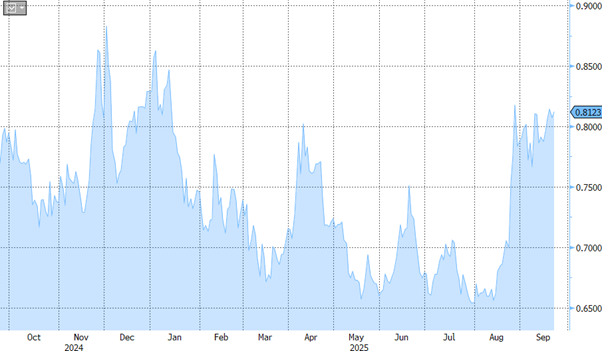
First domino falls
Fitch’s decision on 12 September made it the first major agency to remove the country’s AA-rated status, citing “increased fragmentation and polarisation of domestic politics”. With ratings due in the coming months from Moody’s (24 October) and Standard & Poor’s (28
November), concern over debt sustainability looks set to continue. Perhaps more worryingly for French investors is the convergence of OAT yields with peripheral nations. Greece – historically a pariah state in EU fiscal terms – actually has a lower yield on its 10-year bonds than France, indicative of the persistent uncertainty around the French budget, despite a worse credit rating for the peripheral nation.
| Nation |
Fitch Credit Rating |
Fitch Outlook |
10-Year Yield |
| Greece |
BBB- |
Positive |
3.398% |
| France |
A+ |
Stable |
3.558% |
| Italy |
BBB |
Positive |
3.541% |
Source: Bloomberg and Validus analysis, as of 22nd September 2025
A further downgrade from either / both of Moody’s and S&P could exacerbate the institutional sell-off of French debt, compounding fiscal woes that the fragile government is striving to address. Meanwhile, fiscal consolidation continues to be an uphill battle: France’s tax-to-GDP is already the highest in the EU at 45.6%, while unemployment fears are at 10-year highs – suggesting austerity must fall elsewhere in the economy.
Resilience – up to a point
The outlook is clearly bleak for the French consumer and French assets. However, contagion has so far been limited to France. The National Institute of Statistics and Economic Studies (INSEE) has even increased its 2025 GDP estimates to 0.8% from June forecasts of 0.6%, suggesting a degree of underlying economic resilience, although French outperformance vis-à-vis the bloc is likely to end this year.
Euro on a knife-edge
Should Lecornu both form a united government and pass fiscal legislation, further upside to the euro is likely; in recent days it has reached levels against the dollar not seen since 2021. In the more likely event that the legislative impasse continues, and credit rating downgrades are issued, spillover into European assets is a clear risk, alongside higher debt-servicing costs. Furthermore, any presidential election outcome that jeopardises Macron’s position—not presently our base case—would add further downside risk to the common currency. As it stands, the next French presidential election is not expected until Q2 2027.
Prepare for both paths
For risk managers, the French political saga underscores the difficulty of navigating markets when policy outcomes are binary and volatility is elevated. The potential paths ahead are stark: either a breakthrough in coalition-building that restores confidence, anchors French debt spreads, and lends fresh support to the euro — or a continued stalemate that invites rating downgrades, widens spreads, and triggers broader European contagion.
In such an environment, agility is key. Portfolio positioning must remain flexible enough to capture potential EUR upside if fiscal clarity emerges, while staying hedged against an adverse spiral in spreads and risk assets should the impasse deepen. The coming months will test the market’s faith in European unity; risk managers would do well to prepare for both revolution and stability in equal measure.