
As a longtime lawmaker and former minister under Shinzo Abe, Takaichi’s platform emphasizes economic revitalization through “Abenomics”-style policies, including fiscal stimulus and structural reforms. Her immediate challenges include navigating a minority government, addressing inflation, and bolstering alliances amid simmering U.S.-China tensions. Political experts view her leadership as a trial by fire, balancing hawkish foreign policy with domestic reforms to restore public trust.
Japan’s Economy in 2025: Resilient, But Tested
Amid these political shifts, Japan’s economy has shown modest resilience this year. Real GDP growth accelerated to 0.3% quarter-on-quarter in the second quarter of 2025, surpassing expectations and building on an upward revision from the first quarter. This expansion was driven by stable domestic demand, robust exports—particularly from large manufacturers—and a rebound in private consumption. However, headwinds persist, including political upheaval, global economic slowdowns, and persistent inflation pressures.
The Bank of Japan (BOJ) anticipates a continued moderate recovery, with exports and production rising as overseas economies stabilize. Challenges include a shrinking workforce due to ageing demographics, mounting public debt, and external risks like U.S.-China trade tensions, which have fueled safe-haven demand for the yen, particularly in the first half of 2025.
Recent data indicates some strength: industrial production and retail sales have improved, while unemployment remains low at around 2.5%. Yet growth outlooks have been revised downward, reflecting volatility from political transitions and global uncertainties. Overall, while not in recession, the economy requires sustained policy support to achieve a virtuous cycle of growth and inflation.
BOJ Policy (In)Action
The Bank of Japan’s most recent Monetary Policy Meeting, which concluded on October 30, 2025, maintained a steady course amid the new political landscape. In its first gathering under Prime Minister Takaichi—an advocate of expansionary policies—the board voted 7-2 to keep the short-term policy rate at 0.5%, marking the sixth consecutive hold. Dissenters Naoki Tamura and Hajime Takata pushed for a hike to 0.75%, citing inflation risks, but the majority prioritized data assessment.
Governor Kazuo Ueda emphasized the need for more economic indicators before resuming hikes, while signaling a potential increase as soon as December 2025 or January 2026, contingent on wage momentum and inflation trends. No changes were made to quantitative easing tools, underscoring a gradual normalization path from ultra-loose policies.
USD/JPY – A Stretch of Potential Yen Weakness
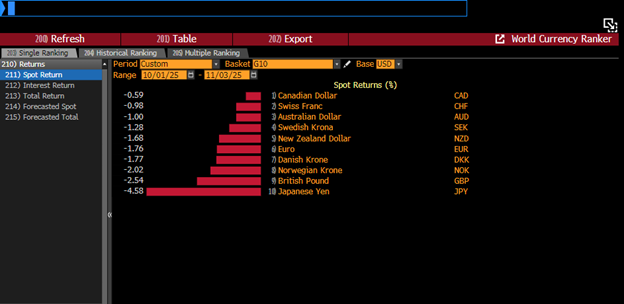
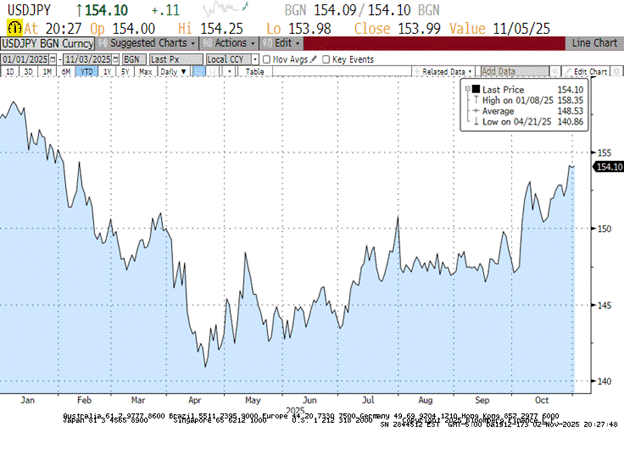
JPY was the weakest G10 currency against the USD in October, reflecting Takaichi’s rise and her bias for expansionary fiscal policies alongside BOJ’s rate hold and dovish tilt at the recent meeting.