
On June 17, 2026, Kevin Warsh presided over his first Federal Open Market Committee (FOMC) meeting as the Chair of the Federal Reserve, succeeding Jerome Powell. The committee unanimously voted to maintain the target range for the federal funds rate at 3.50%–3.75%, marking the fourth consecutive hold.
This decision came amidst a difficult backdrop: inflation remains above the Fed’s 2% target, energy prices have lifted by the Middle-East conflict, and the economy continues to show enough resilience to complicate the case for near-term cuts.
The rate decision itself was not the story – but rather Warsh’s tone. The policy statement was notably streamlined—reduced to approximately 132 words from over 300 in prior releases—eliminating forward guidance language that had signaled potential easing. This marked a deliberate stylistic and substantive break, prioritizing clarity and flexibility over detailed signaling.
The Dot Plot Delivers the Hawkish Surprise
The most significant development came from the updated Summary of Economic Projections (SEP), including the closely watched “dot plot.”
The median projection for the federal funds rate at end-2026 rose to 3.75%, compared with the current midpoint of 3.625%. Projections for 2027 and 2028 were also revised upward, reinforcing the message that rates may remain elevated for longer than markets had previously expected.
Nine of the 18 participating officials (Warsh abstained from submitting projections) anticipated at least one rate increase by year-end, with several expecting multiple hikes. Only one projected a cut.
Economic forecasts showed real GDP growth for 2026 revised down modestly to 2.2% from 2.4%, unemployment steady near 4.3%, but inflation markedly higher: total PCE at 3.6% and core PCE at 3.3% for 2026.
Warsh notably declined to submit his own dot, consistent with his long-held skepticism of the SEP’s structure, which he views as potentially constraining policy flexibility. He encouraged colleagues to continue but signaled openness to broader reforms.
Warsh Breaks from the Powell Playbook
In his debut press conference, Warsh made it clear that his appointment was more than a mere personnel change – it’s a change in style.
He struck a confident, focused tone centered on price stability. He emphasized that, “We recognize that inflation has been running well ahead of the Fed’s long-stated inflation goal of 2 percent. That’s been going on for more than five years. Persistently high prices are a burden for the American people. But the recent past need not be prologue. I am pleased to report that members of the FOMC are unambiguous and unanimous—this committee will deliver price stability.”
He announced five task forces to review communications, the balance sheet, data sources, productivity/jobs, and the inflation framework, enlisting external experts with initial findings expected in the fall.
Warsh made it clear that forward guidance was “not well suited to the current policy conjuncture” and framed the shorter statement as giving “the facts as best we can judge it.”
Differences from Powell are evident in style and substance. Powell’s communications were more expansive, data-dependent, and included detailed forward guidance with regular press conferences. Warsh favors less talk, fewer projections, and greater agility, avoiding binding signals. He repeatedly stressed unanimous commitment to inflation control without Powell-style focus on the balancing of dual mandates.
Markets Reprice the Risk of Further Tightening
Markets reacted swiftly to the hawkish tilt.
The U.S. Dollar Index rose sharply, hitting multi-month highs supported by higher rate expectations. Short-term Treasury yields jumped notably: the 2-year note rose about 15 basis points to around 4.20%, while the 10-year increased more modestly (around 7 basis points to ~4.49%).
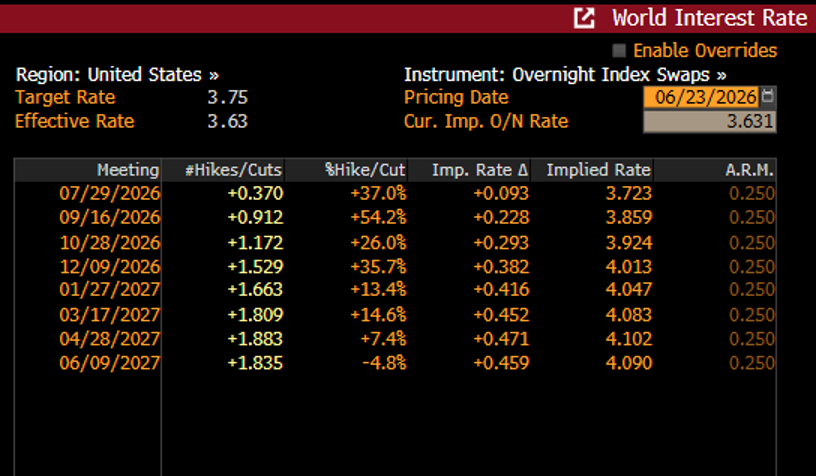
Traders also repriced policy expectations, pricing in a full hike by October and around 38 basis points of tightening by year-end. That shift weighed on gold and equities, both of which came under pressure as the dollar strengthened.