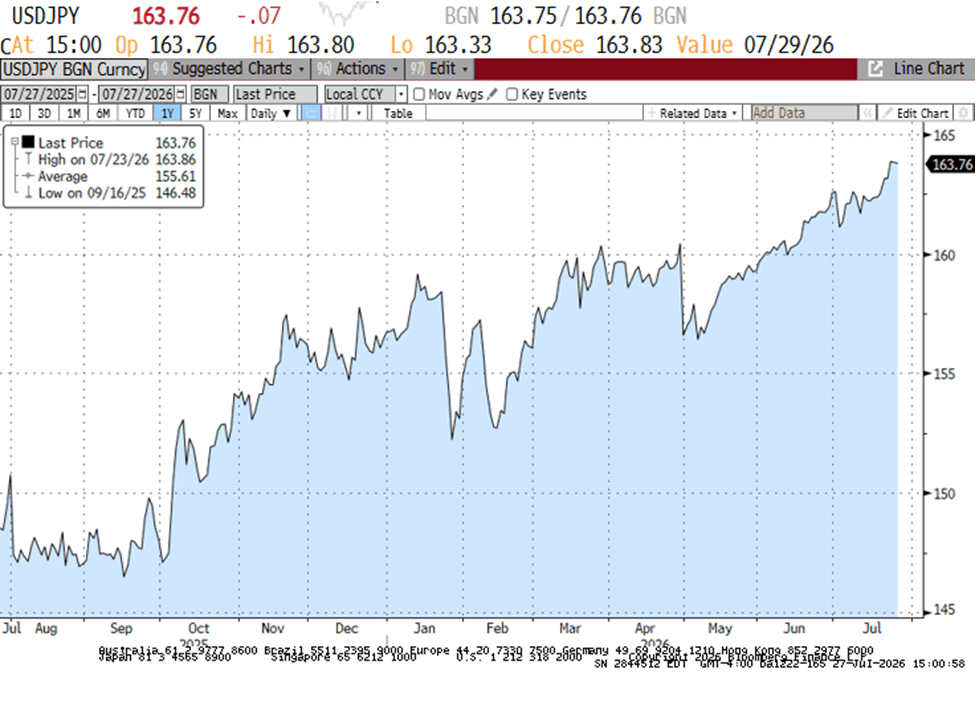

The Japanese yen has fallen to levels not seen in around 40 years, trading near 163–164 against the US dollar in July 2026. Its persistent weakness comes despite previous efforts by Japanese authorities to stabilize the currency.
A weaker yen can benefit Japanese exporters by making their goods more competitive overseas, but it also raises the cost of imports, particularly energy and food. This can add to inflationary pressures and squeeze household purchasing power. Against this backdrop, attention has increasingly turned to Japan’s underlying economic fundamentals and the effectiveness of policymakers’ efforts to support the currency.
Drivers of Yen Weakness: Fiscal Strain, Mixed Economic Data and Wide Rate Differentials
One factor weighing on the yen is Japan’s challenging fiscal position. Public debt remains among the highest in the developed world, even as the debt-to-GDP ratio has stabilized or declined modestly in some projections. Persistent primary deficits, combined with pressures from aging-related spending, stimulus measures and higher defense expenditure, continue to raise questions over long-term fiscal sustainability. Political shifts and the prospect of further fiscal packages could add to these concerns.
Recent Japanese economic data have also painted a mixed picture. The labor market remains relatively tight, with unemployment around 2.5% and wage growth strengthening. However, GDP growth has been uneven, with periods of contraction followed by only modest rebounds, while higher energy prices resulting from geopolitical tensions have complicated the outlook.
Inflation has also fluctuated. Headline measures have at times been pushed higher by food and energy prices, while underlying inflation has varied around the Bank of Japan’s (BOJ) 2% target. Taken together, the data point to an economy that is improving but remains far from robust, limiting support for the yen.
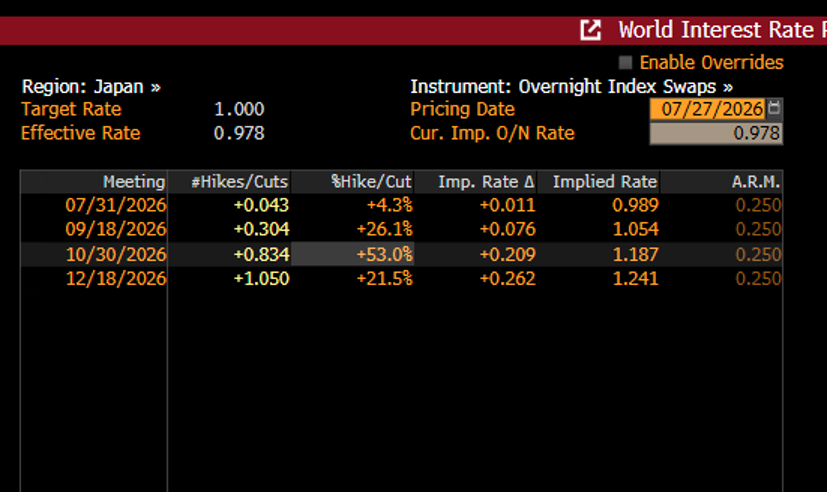
The interest-rate differential between the US and Japan remains another important driver. The Federal Reserve has maintained significantly higher rates, while the BOJ has pursued a more gradual path toward monetary policy normalization. Even after the BOJ raised its policy rate to 1% in June 2026 – its highest level since 1995 – the gap remains substantial. This continues to incentivize capital flows toward higher-yielding US assets, placing downward pressure on the yen.
Japanese Authorities’ Response: Interventions and BOJ Measures
In response to yen depreciation, Japan’s Ministry of Finance (MOF) has deployed large-scale foreign exchange intervention. In April–May 2025, Japan spent around ¥11.7 trillion, or approximately $73 billion, in one period to support the currency, following similar action in previous episodes.
Such interventions have provided periods of temporary relief, but the yen has often resumed its decline once the immediate pressure eased. This highlights the limits of direct intervention when broader macroeconomic and interest-rate fundamentals remain unfavorable.
The Bank of Japan has complemented these efforts through monetary policy tightening and communication. Rate increases, including the move to 1% in June 2026, are gradually narrowing the interest-rate gap while also addressing domestic inflation risks.
BOJ officials have indicated that further tightening remains possible if economic and inflation conditions warrant it, while continuing to monitor the impact of exchange-rate weakness on imported inflation. Verbal intervention and coordination with the MOF have also sought to discourage excessive currency moves.
Policymakers therefore face a delicate balancing act: supporting the yen to contain import costs and financial instability without tightening policy so aggressively that it undermines domestic growth or disrupts financial markets.
Chart 1: USDJPY spot chart over the last 1Y