
The initial reaction was that the meeting had a dovish bias. This view was supported not only by the two members who supported a more aggressive rate cut but also by the unexpected dissent from Catherine Mann. Regarded as one of the more hawkish members, Mann had consistently backed rapid rate hikes throughout 2022 and 2023 and had opposed any rate cuts in both August and November of last year. However, she has since said that the larger cut was to “cut through the noise.”
Meanwhile, the BoE has slashed its growth forecast for 2025 to 0.75% (from 1.5% previously) and increased its forecast for unemployment from 4.3% to 4.8% in the wake of Rachel Reeves’ decision to hike employers’ national insurance contributions. Nevertheless, the central bank emphasised it would take a “careful” approach to cutting rates. It forecasts that inflation will rise to 3.7% before gradually easing back to its 2% target over the next two years.
Unsurprisingly, sterling came under immediate pressure, swiftly falling against its major counterparts in the minutes following the announcement. However, the dip proved to be relatively short lived. Upon closer inspection, the messaging was nowhere near as dovish as first appeared. Amidst the turbulence, Governor Andrew Bailey was quick to caution against markets reading too much into the vote, highlighting that the vote split should not be seen as a communication tool.
Inflation risks to temper rate easing
Market expectations point to a measured easing of rates over the coming months. By year’s end, markets are pricing in 63 bps worth of cuts, roughly equating to two to three quarter-point reductions. The next cuts are pencilled in for May and August. Looking further ahead, its then 50:50 chance that we see a third cut in either November or December.
Despite these forecasts, we think the risks tilt towards a slightly less dovish stance based on current data. Headline inflation is expected to remain elevated in the months ahead, while wages continue to rise, currently climbing above 5%. Meanwhile the service sector maintains persistent price stickiness. We find ourselves siding with Megan Greene, thinking that “the risk of cutting too early or too aggressively is greater than going a bit more slowly.”
Pound’s surprising resilience
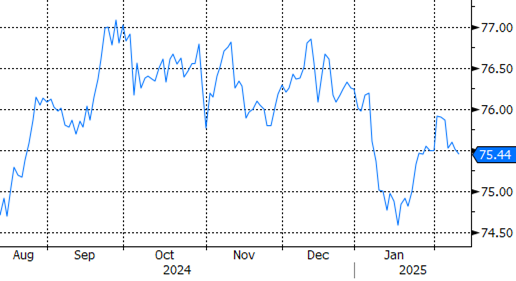
In recent weeks, the pound has held up reasonably well against its peers, even as the dollar remains the dominant force. This perhaps maybe isn’t surprising given US economic outperformance and the looming inflationary risks associated with President Trump’s protectionist policies. A crucial indicator of sterling’s renewed strength is the recent positive flip in the interest rate differential with the dollar for maturities beyond six months—a reversal from its usual negative stance for the pound. This shift means that USD denominated vehicles hedging GBP assets can once again lock in a more attractive hedging pick up. In part, this results from expectations for further cuts from the BoE, but also reflects the notion that the Fed might be forced to keep rates higher for longer given the inflationary risks posed by Trump’s policies. Looking elsewhere, when measured against its G10 counterparts, the pound has held up well.