
Over the past week, longstanding trade tensions between the United States and Canada culminated in the abrupt collapse of intensive negotiations and the imposition of reciprocal tariffs, further straining one of the world’s largest bilateral trading relationships.
On August 22, the US implemented 50% tariffs on roughly $20 billion of Canadian goods under Section 338 of the Tariff Act of 1930. Canadian Prime Minister Mark Carney responded by suspending talks, recalling negotiators to Ottawa, and pledging retaliation, with Canadian counter-tariffs set to take effect on September 8.
The breakdown marks a significant deterioration in relations between two closely integrated economies, raising the prospect of supply-chain disruption, higher consumer costs and broader consequences for North American growth.
Background: The Rise of Trade Tensions
Tensions have simmered since the current US administration took office in January 2025. Washington has launched a wide-ranging tariff program that disrupted decades of relatively free trade under the US-Mexico-Canada Agreement (USMCA).
Early measures included tariffs on Canadian steel, aluminum, automobiles and lumber, prompting Canadian retaliatory tariffs on US goods as well as provincial restrictions on American alcohol in several jurisdictions.
Canada later rolled back some of its broader retaliatory measures, restored certain market access and made other concessions, including adjustments related to digital services taxes and infrastructure. However, significant points of friction remained, including dairy market access, auto trade rules and alcohol restrictions.
Escalation in Mid-2026 and Intensive Negotiations
USMCA review discussions in 2026 failed to produce a long-term extension, although the agreement remains in force under its existing terms until at least 2036.
In July 2026, the US escalated by announcing 50% tariffs on approximately $20 billion in Canadian imports – about 5% of Canada’s exports to the United States – targeting products such as wine, dairy, cement, clothing, furniture, fishing rods, and hockey equipment.
The tariffs were framed as a response to Canadian practices that the US considered discriminatory toward its auto, dairy and alcohol industries. The measures were initially scheduled to take effect on August 19.
Intensive negotiations followed through July and August, with Canada signaling a willingness to drop remaining retaliatory tariffs on steel, aluminum and autos in exchange for substantial US tariff reductions, while also encouraging provinces to restore sales of US liquor.
From Near-Deal to Breakdown
Optimism peaked mid-August when the US administration announced a temporary pause and said an agreement was close, subject to final documentation.
Reports indicated that potential US concessions included reducing steel and aluminum tariffs from 50% toward 25%, easing auto tariffs from 25% toward 15% or lower depending on US content, and eliminating certain softwood lumber duties, while Canada would address US priorities.
However, talks collapsed late on August 21, with Carney citing last-minute US changes that were “unfair, uneconomic,” fell short of Canadian objectives and threatened Canada’s economic reliability and sovereignty. These reportedly included limits on auto tariff relief for medium- and heavy-duty trucks, demands affecting cultural and French-language protections, and pressure related to Canada’s trade policies with non-US partners.
US Trade Representative Jamieson Greer countered that Canada had introduced new demands and reversed previous commitments, while rejecting an offer of preferential treatment.
The US tariffs took effect early on August 22 on the targeted goods, in addition to existing sectoral duties. Canada’s response, detailed by Carney, will match the value “dollar for dollar,” focusing on US steel, dairy, appliances, agricultural equipment, pulp and paper, and electronics, with details forthcoming and implementation set for September 8.
Both governments have accused the other of undermining what had appeared to be a near-agreement, highlighting the growing lack of trust between the two sides.
Economic Consequences for Both Countries
For now, the direct economic impact appears relatively contained, with the new US duties covering only around 5% of Canadian exports to the United States.
Analysts estimate a potential Canadian GDP hit of roughly 0.3% with concentrated effects in Ontario, Quebec and export-oriented manufacturing. Canadian consumers and businesses will encounter higher costs and reduced choice once retaliatory tariffs take effect, as at least part of the additional cost of tariffs is typically passed through to buyers.
For the United States, effects are smaller in aggregate given the relative size of the economy and the limited share of Canadian imports affected. However, specific industries – including agriculture and manufacturing exporters – as well as businesses reliant on Canadian inputs could face greater pressure.
Higher costs for intermediate goods also risk adding to inflation across highly integrated North American production networks. More broadly, both economies stand to lose efficiency as tariffs disrupt supply chains that have developed across the border over decades.
Politically, the dispute risks deepening mutual suspicion and making cooperation in other areas more difficult.
What the Dispute Means for USD/CAD
Canada’s greater dependence on the US export market means that periods of heightened trade uncertainty and weaker Canadian growth have typically placed downward pressure on the Canadian dollar, pushing USD/CAD higher.
Market pricing for Bank of Canada rate hikes has also been pared back relative to the US, potentially adding further pressure to the loonie. Against this backdrop, USD/CAD volatility is likely to remain elevated as markets assess both the economic impact of the tariffs and the prospects for renewed negotiations.
What Comes Next?
The situation remains fluid in the run-up to Canada’s September 8 tariff deadline. Further details of the Canadian measures are expected shortly, while the gap between their announcement and implementation may provide a window for quiet diplomacy.
Business groups on both sides have expressed dismay and may lobby for relief. Political incentives, however, remain different: the US administration can portray the measures as evidence of a tougher stance on trade, while Carney has emphasized the need to defend Canadian economic interests and sovereignty.
Further escalation remains possible if either side introduces additional measures. However, the economic costs of prolonged disruption to a bilateral trading relationship worth around $1 trillion provide a strong incentive for eventual re-engagement, potentially through broader USMCA discussions or sector-specific agreements.
Markets and policymakers will therefore watch closely for any signals of renewed talks, provincial alcohol policy shifts, or calibrated exemptions.
In the meantime, businesses face greater uncertainty, higher costs and potentially significant supply-chain disruption in an already increasingly protectionist trading environment.
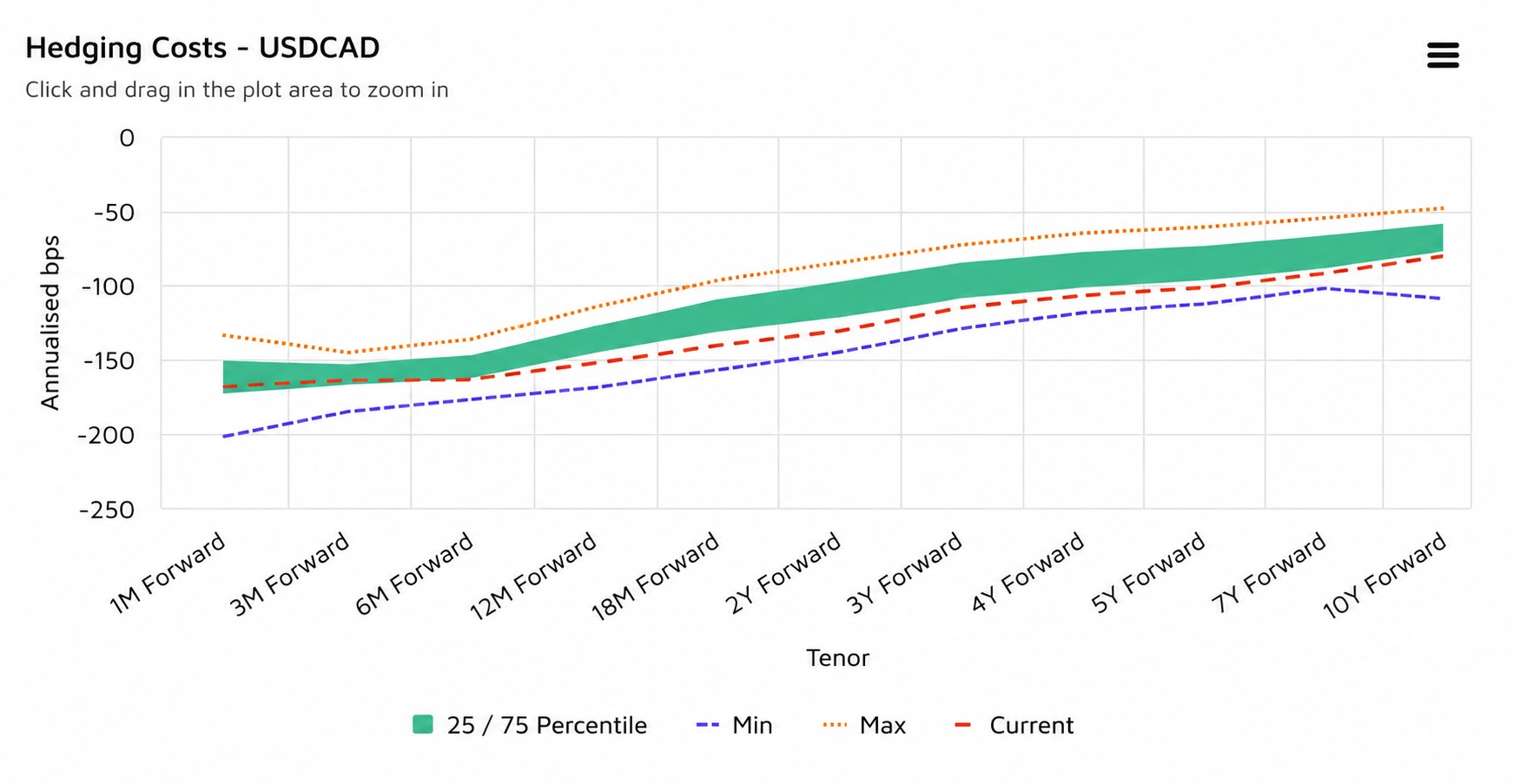
In an environment of potentially sustained CAD weakness, USD investors could use FX forwards to hedge for CAD weakness as USDCAD FX forwards carry offer an attractive pickup.