
The Real Yield Story: when will investors return to US treasuries?

Global Bonds: Yield Another Day

08 October 2026

Key Takeaways


  • Global bond markets are repricing sharply. Sovereign yields across developed economies have risen to multi-decade highs, increasing financing costs for governments, households and companies. 
  • AI infrastructure spending may be supporti higher real interest rates by strengthening investment and economic activity. 
  • Quantitative tightening is shifting price-setting power back towards private investors, who are demanding greater compensation for duration, inflation uncertainty and fiscal risk. 
  • Borrowers should assess floating-rate exposure, refinancing risk and hedge maturity together, focusing less on forecasting rates and more on setting an acceptable ceiling for financing costs.  

“My approach to bonds is pretty much like my approach to stocks. If I can’t understand something, I tend to forget it.” – Warren Buffett

Global bond markets are experiencing a reckoning. Benchmark sovereign yields across developed economies have climbed to levels unseen in decades, raising the cost of capital for governments, households and corporates alike. 

Inflation may have instigated current dynamics, but it does not fully explain the magnitude of the sell-off. Persistent energy pressures, resilient economic growth, deteriorating fiscal positions, quantitative tightening and an extraordinary wave of AI-related capital expenditure are increasingly competing for the same finite pool of global capital. 

For investors, the question is therefore no longer simply how high central banks will take interest rates. It is how much compensation markets will demand to fund an increasingly capital-hungry global economy. 

What has caused the sell-off in sovereign debt? 

While the catalyst has been inflation, the explanation for the magnitude of the move is multifaceted. Conflict in the Middle East has delivered a global energy shock reminiscent of that following Russia’s invasion of Ukraine in February 2022. Oil prices persistently above $100/barrel have driven headline inflationary pressures higher globally, particularly across energy-import-dependent Europe – something discussed at length in our recent piece: “Cold homes, hot spreads, hard choices: Europe’s winter”.

Compounding matters is an unprecedented new competitor for global capital: artificial intelligence. 

The world’s largest technology companies, historically able to fund investment from internal cash flows, are increasingly turning towards debt markets to finance AI infrastructure. Morgan Stanley estimates AI-related global debt issuance could approach $570bn this year, as hyperscalers invest indata centres, semiconductors and computing infrastructure. 

For sovereign borrowers, this represents direct competition for capital. When highly-rated technology companies offer attractive yields over government bonds, sovereign issuers must compete harder for the marginal dollar, pound or euro. At the same time, public-sector refinancing needs are large and central banks are withdrawing demand through quantitative tightening.  

But AI’s impact extends beyond bond supply. The investment boom is supporting economic activity at precisely the moment central banks are attempting to restrain demand. Moreover, should AI deliver the productivity gains its proponents expect, stronger potential growth and higher prospective returns on capital could justify a higher neutral real interest rate. 

The irony is striking: the technology promising to make the global economy more productive may simultaneously help keep the price of money structurally higher. 

 The ongoing quantitative tightening  programs from the Bank of England, Bank of Japan and ECB compound matters by removing some of the least price-sensitive participants from global bond markets, leaving private capital to demand greater compensation for duration, inflation and fiscal risk. 
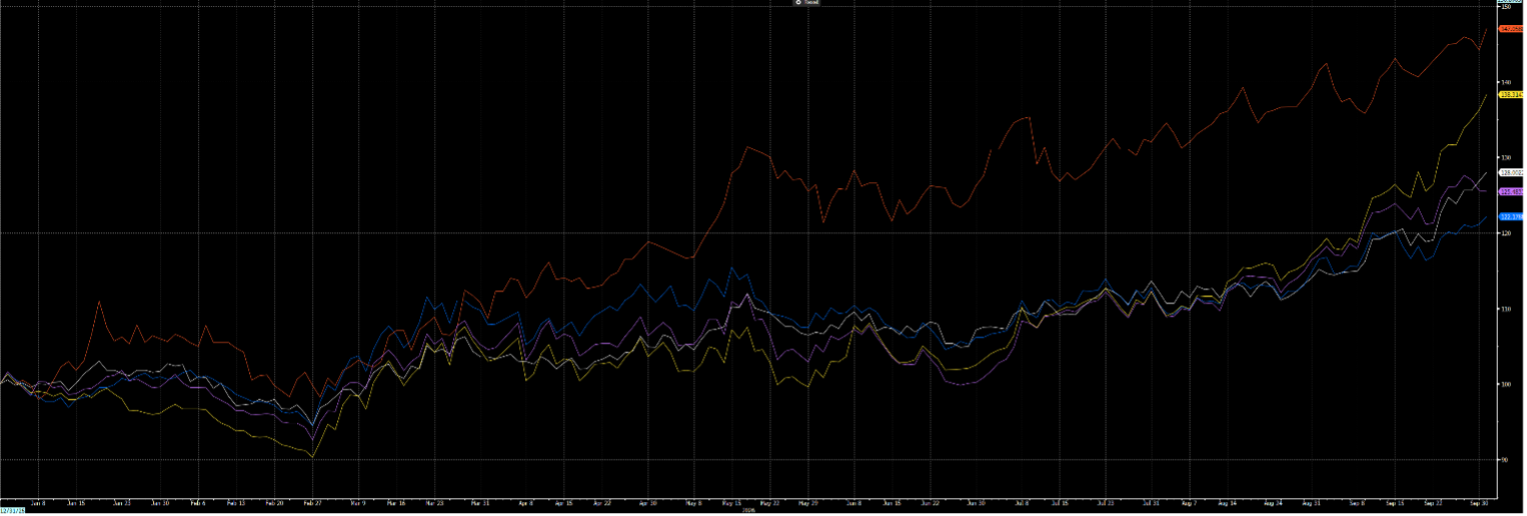
 

Chart 1: Nominal 10Y government bond yields – US, UK, Germany, France and Japan, normalized.

Source: Bloomberg, as of 2nd October 2026.

The resulting repricing has been substantial. The US 10-year Treasury yield briefly touched 5.34% at the beginning of October, its highest since 2002, having risen almost 90bps during Q3. Across the Atlantic, the UK’s 30-year gilt yield breached 6% for the first time since 1998, while 10-year borrowing costs climbed to their highest since 2007. 

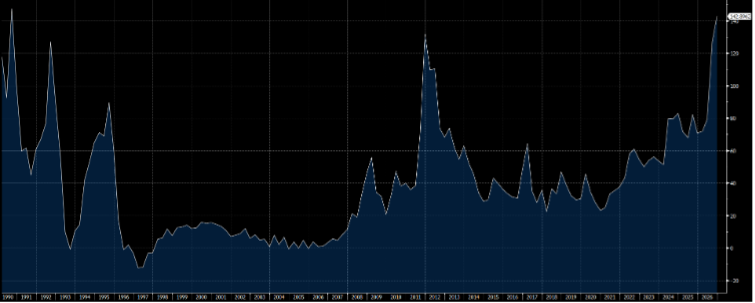
Perhaps more telling is the growing differentiation within Europe. French 10-year borrowing costs have approached 5%, while the spread over equivalent German Bunds has widened beyond 150bps, reaching levels not seen since the eurozone sovereign debt crisis. Investors are no longer indiscriminately selling duration; increasingly, they are distinguishing between sovereigns based on fiscal credibility. 

Adding to those concerns, France plans to issue a record €340bn of medium- and long-term government debt in 2027, net of buybacks, up from €310bn this year. 

In short, while global yields are rising together, not all basis points are treated as equal by global investors.

Chart 2: OAT-Bund 10Y Spread

Source: Bloomberg, as of 2nd October 2026.

The central bank quandary 

The conundrum for policymakers is that bond markets are increasingly doing part of their job for them. Higher sovereign yields feed directly into mortgage pricing, corporate funding costs and broader financial conditions, restraining investment and consumption independently of changes to overnight policy rates. 

 This creates an increasingly delicate balancing act. Tighten too little and policymakers risk allowing the energy shock to become embedded in underlying inflation, Tighten too aggressively at a time when marketsare demanding greater compensation for duration and fiscal risk, can lead monetary and market-led tightening to be at risk compounding one another. 

Why is it different this time? 

For much of the post-Global Financial Crisis era, global capital markets were defined by abundance. Inflation was subdued, private-sector investment relatively weak and central banks absorbed enormous quantities of sovereign debt through quantitative easing, helping suppress yields to near-zero or even negative levels. 

 Today’s backdrop increasingly resembles the inverse. Central banks are shrinking their balance sheets, governments face substantial borrowing and refinancing requirements, while defence, energy infrastructure and AI are simultaneously competing for capital. 

 Crucially, this changes the identity of the marginal buyer. Under quantitative easing, central banks purchased sovereign bonds to achieve policy objectives and were consequently relatively insensitive to price. Under quantitative tightening, governments must increasingly persuade private investors to absorb that supply – and those investors require compensation for duration, inflation uncertainty and fiscal risk. 

This helps explain why the current move has impacted the long end of global curves. Central banks retain considerable influence over short-term rates, but the clearing price for 10-, 20- or 30-year government debt is ultimately determined by the market. Widening intra-eurozone sovereign spreads and multi-decade highs in US and UK borrowing costs suggest investors are becoming increasingly selective about the price at which they will hold sovereign duration. 

 The result may be a fundamentally different fixed-income regime. For borrowers, the extraordinarily cheap capital of the post-GFC era may not readily return. For investors, however, capital providers are once again being paid meaningfully to lend – and afforded greater discretion over whom they are willing to fund. 

The emerging dynamic in fixed income has clear implications for risk managers. Floating-rate exposure, refinancing risk and hedge maturity should be assessed together, not in isolation. When the path of rates is uncertain but the cost of being wrong is increasingly material, hedging is less about forecasting the next move rather than setting an acceptable ceiling for financing costs.  

Author

Harry Woolman, Global Capital Markets Associate

By submitting this form you are agreeing to our Privacy Policy

Let’s talk.

Whether it’s about how Validus can protect your portfolio returns, streamline your fund finance operations, or bring your risk and financing data together in our Horizon platform – we’d like to hear from you.

90 Whitfield Street
5th Floor
London
W1T 4EZ

+44 203 923 8575