Political implications
The results fundamentally alter the political landscape for the remainder of Trump’s second term:
- Loss of legislative control: In 2025, Republicans used unified control to pass sweeping tax cuts. That era is now over with Democrats chairing congressional committees and setting the legislative agenda. Nonetheless, the President retains his veto power, which could result in gridlock rather than reversal, with clashes likely to be more confrontational than in 2019–2020.
- Investigations: With a view to addressing one of voters’ most prominent concerns, senior Democrats have promised major probes into what they describe as President Trump’s ‘tentacles of corruption’. Betting markets suggest an approximately 63% chance of the President being impeached before the 2028 election.
- Approval and mandate: The President’s approval rating stood at around 38% heading into the election, and voters in the AP VoteCast survey of around 100,000 respondents broadly blamed his policies for rising prices and economic weakness.
- Iran war fallout: The unpopular US–Israel war against Iran was a significant drag on the Republican vote, leaving Defence Secretary Pete Hegseth looking vulnerable.
- 2028 outlook: The Republican coalition that appeared to be realigning in 2024 – with gains among Hispanic, Black and working-class voters – showed significant cracks, with younger voters swinging back to the Democrats by more than 30 percentage points.
Economic implications
- Limited direct macro impact: Morgan Stanley characterises the overall macro impact as modest. The key channel is a potential reversal of the Medicaid and SNAP (food stamp) cuts enacted under Republican control, which could give consumer spending a small boost.
- Deregulation rollback risk: Wall Street firms and fintechs that benefited from the President’s deregulatory agenda – covering crypto, prediction markets and private markets – now face a more adversarial Congress. For private capital, this is the area to watch: initiatives such as the August 2025 executive order opening up 401(k) plans to private markets are likely to face greater scrutiny through committee hearings, even if Democrats lack the votes to overturn executive action outright.
- Tariff constraints: Democratic control is expected to limit the President’s ability to escalate tariffs further, which analysts see as offering trading partners some relief, albeit with new uncertainties.
- Fiscal trajectory: The lame-duck Republican Congress faces a packed agenda, including FY2027 government funding, Iran war financing and extensions to agricultural and nutrition programmes, all of which now face a tougher passage.
- Credit positive: Scope Ratings described the results as ‘credit positive’ for the US, citing the orderly transfer of congressional power and the President’s swift acceptance of the outcome.
Outlook for rates and FX
Looking ahead, expectations that a Democratic Congress will constrain Trump’s fiscal and inflationary agenda have pushed rates lower across the curve, with the long end – where fiscal policy and the term premium matter most – leading the way.
JPMorgan has closed its 10s30s Treasury curve steepener, citing risks around upcoming jobs data and an increased likelihood of Iran war de-escalation following the results. De-escalation would reduce the inflation risk premium embedded in longer-dated bonds, leaving room for the long end to rally further and the curve to flatten.
The front end tells a different story. Short-dated rates are driven by the Fed and inflation data rather than by Congress. Markets are pricing a high probability (around 82%) that the Fed will raise rates by 25bp when it meets on 9 December, with a second hike to follow in Q2 2027. We think this pricing is about right given recent inflation data and the Fed’s desire to show its independence, but things could change if oil prices were to fall sharply over the next month. For borrowers, SOFR swaps have moved 5bp since the election, and the cost of hedging floating-rate debt with caps or swaps has fallen accordingly.
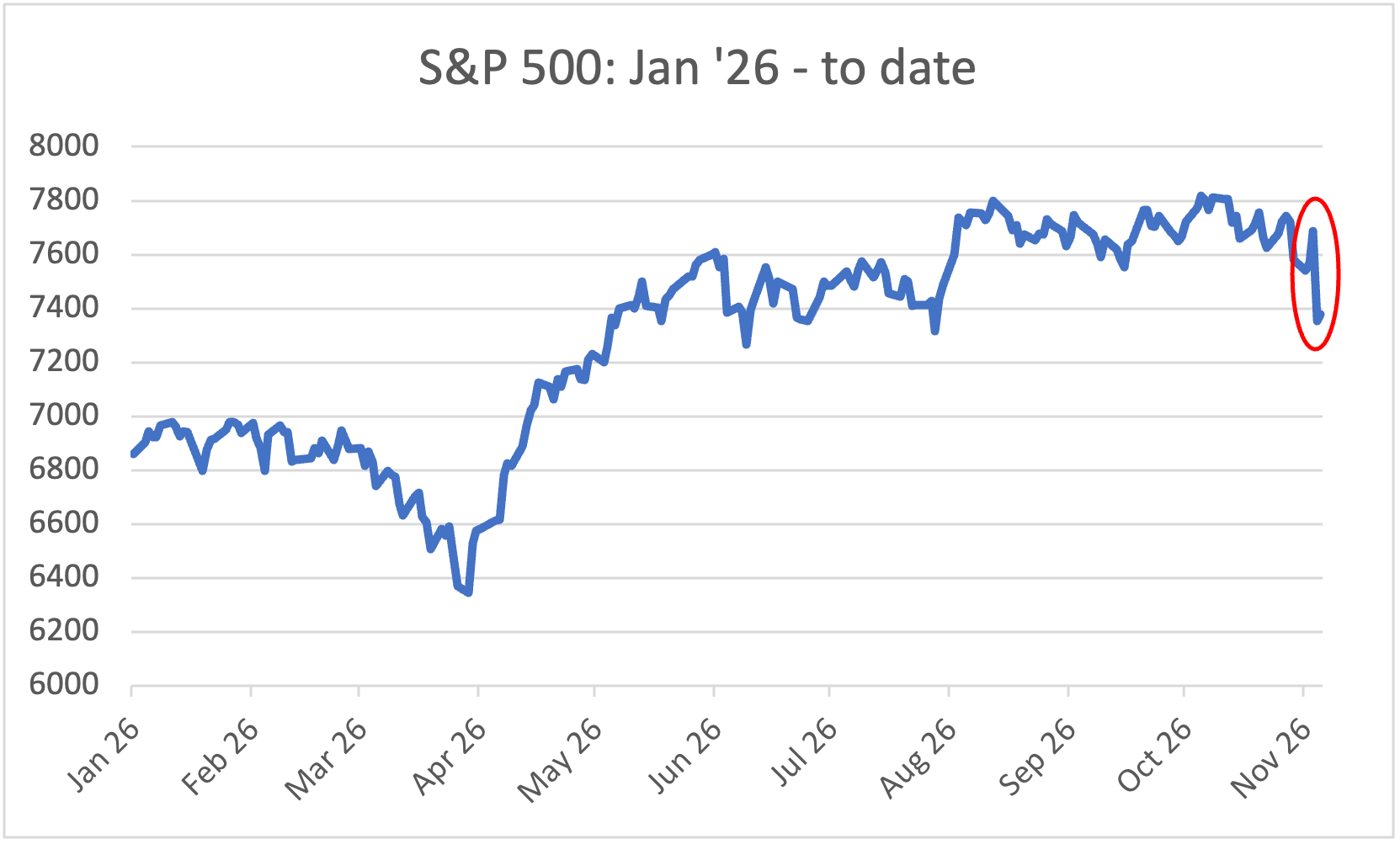
The outlook for the dollar is less clear-cut, because two forces are pulling in opposite directions. On Wednesday, the dollar weakened as markets reacted to the political result; on Thursday, it rallied as risk appetite collapsed, underlining its role as a safe haven. Interest rate differentials matter too, and it would be short-sighted to ignore them. Neither CFTC positioning data nor risk reversals in the options market point strongly either way, suggesting risks are finely balanced. There is also every chance that European bond markets return to focus in the near term, given political uncertainty and France’s dire finances.
Taking this all together, we have lowered our near-term forecasts for EURUSD and GBPUSD respectively, reflecting rate differentials and recent safe-haven demand for the dollar. Regular readers will not be surprised to hear that our longer-term bias remains towards a broadly weaker dollar, driven by rebalancing away from a high dependency on US assets.