

The Real Yield Story: when will investors return to US treasuries?

The Real Yield Story: when will investors return to US treasuries?

02 October 2026

Key Takeaways


  • The rise in long-term US yields has persisted despite a Federal Reserve rate increase and US Treasury support for longer-dated bonds
  • Real yields are approaching 3%, near levels last seen around the Global Financial Crisis, but today’s combination of nominal yields and inflation is more comparable with 2000 and the late 1990s
  • Higher real returns could eventually draw investors back into bonds
  • Resurgent or persistent inflation is the central risk

“We’ve seen a material tightening, not just in nominal rates, but in real rates, too, and we’re observing it.”

Chairman Warsh, July 29th FOMC press conference

September brought a Federal Reserve rate increase and what might be described as a “pseudo-intervention” by the US Treasury, which increased the size of its buybacks to support longer-dated bonds. Yet neither step slowed the relentless rise in long-term US rates. The 10-year Treasury yield rose by nearly 0.50 percentage points during the month, reaching 5.30%, its highest level since 2007.

The sell-off initially reflected persistent inflation concerns and the weight of US debt. Its duration, however, now appears to have prompted more structural selling by institutions and asset managers. That would be an unwelcome development: selling can beget further selling, creating a feedback loop at a time when geopolitical and US electoral uncertainty may already be encouraging investors to reduce risk.

The absence of an apparent rebalancing bid is also notable. Bonds materially underperformed equities in September and over the previous quarter, which might ordinarily have led major institutional investors to rebalance from equities into bonds at month- and quarter-end. Those inflows did not appear to materialize.

To assess what may happen next, it is useful to look beyond nominal yields and focus on real rates.
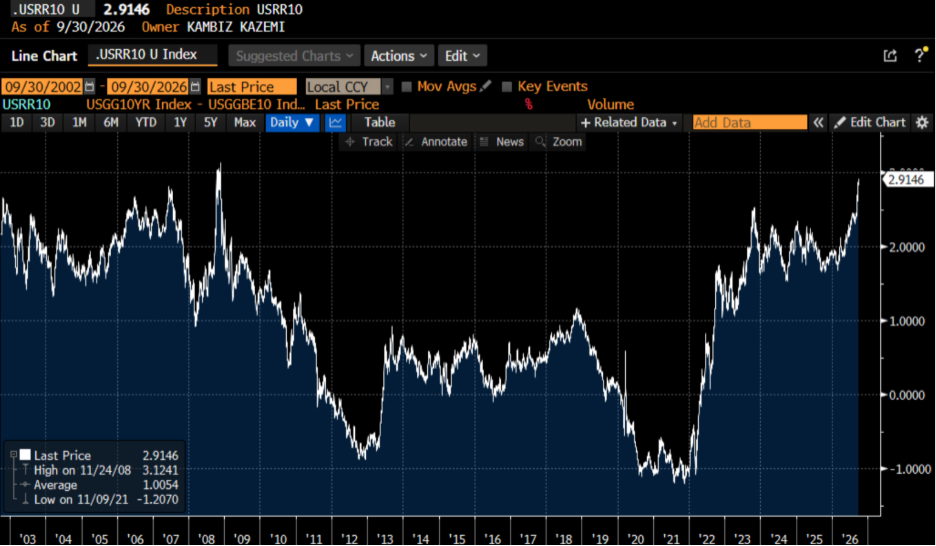

Chart 1: US 10-year real yield, 2002-2026

A real rate is the nominal interest rate minus expected inflation. In practical terms, it represents the return an investor receives after accounting for inflation’s erosion of purchasing power.

As Chart 1 shows, real rates have risen sharply from the negative levels recorded in the post-Covid period, a historically unusual outcome. At that point, investors buying US Treasuries were not merely receiving insufficient compensation for expected inflation; they were accepting a negative return in real terms. In those circumstances, it is understandable that investors might favor other assets, particularly equities.

Real rates are now approaching 3%, a level not seen since the Global Financial Crisis in 2008. The comparison, however, requires care. In 2008, real rates rose because inflation expectations fell sharply into negative territory, while the 10-year Treasury yield stood at only around 3.5%.

A closer historical analogue may be found in 2000 and the late 1990s, when the 10-year yield was in a 5.5% to 6% range and inflation was between 2.5% and 3%. That period also coincided with a Federal Reserve hiking cycle that ultimately brought rising inflation under control.

Where do these observations leave us?

First, the risk of a further bond sell-off is real, particularly if investor confidence deteriorates and reinforces the feedback loop. There are, however, some grounds for optimism.

If inflation is brought under control and expectations remain contained, any further rise in nominal yields will, as a matter of arithmetic, lift real rates. At some point, investors may judge that the return available above inflation is sufficiently attractive for increase their bond holdings.

That point of equilibrium matters. If investors can earn a 4% or 5% real return with relatively low volatility, while equities appear expensive on valuation grounds, the case for stepping back into bonds becomes very compelling.

The principal risk is therefore resurgent or persistent inflation. If long-dated interest rates rise at the same pace as, or more slowly than, inflation, real rates will increase little, if at all. Investors would then have less reason to return as aggressive buyers of bonds.

In our view, the Federal Reserve is likely to be increasingly alert to this risk. That points to a clear resolve to contain inflation, potentially pre-emptively, and to maintaining a hawkish tone.

Author

Kambiz Kazemi, Chief Investment Officer

By submitting this form you are agreeing to our Privacy Policy

Let’s talk.

Whether it’s about how Validus can protect your portfolio returns, streamline your fund finance operations, or bring your risk and financing data together in our Horizon platform – we’d like to hear from you.

90 Whitfield Street
5th Floor
London
W1T 4EZ

+44 203 923 8575