The Real Yield Story: when will investors return to US treasuries?

The Fed Went Quiet. The Market Didn’t.

22 October 2026

Key Takeaways


  • Global yields were already elevated before recent European sovereign spread volatility, with inflation, energy pressures and higher real yields all contributing to the repricing 
  • The AI CapEx boom is creating a major new source of demand for capital, increasing competition across bond markets and helping push term premiums higher 
  • France appears particularly vulnerable because higher global rates are colliding with weak fiscal health, large deficits and more stark growth prospects
  • For borrowers, elevated rates volatility reinforces the importance of reassessing interest rate exposure and taking risk off the table during calmer market windows

A Month of Extremes, Not a Month of Answers

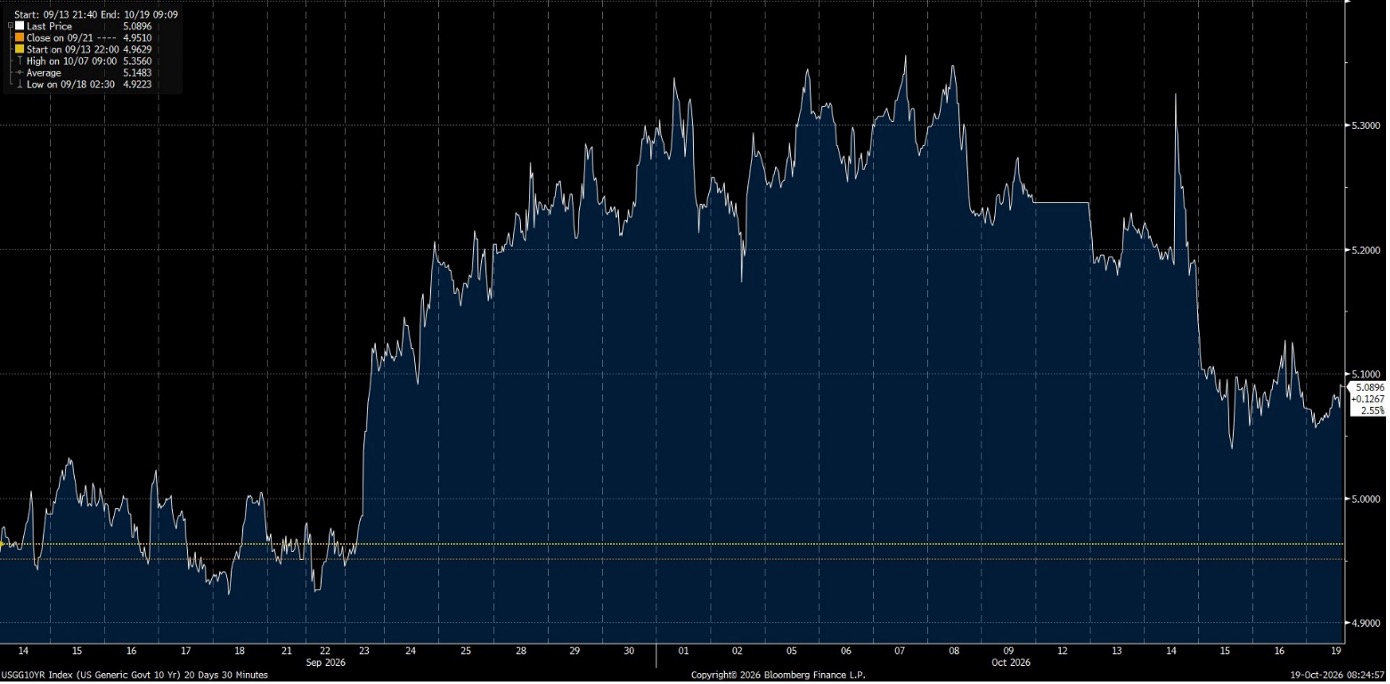
Four weeks of volatile trading, and the standout feature isn’t any single print or speech. It’s the size of the swings in what the market thinks the Fed will do next, swings that have happened without the Fed doing anything. Early October opened hawkish, with Fed Governor Waller reinforcing the case for a hike ahead of a 30-year auction that pushed the long bond above 5.72% on October 8, a level not seen since 2002. The 10-year climbed through the month, peaking intraday at 5.36% on October 7, its highest level since 2002. From its intraday low of 4.92% on September 18, that’s a swing of more than 43 bps in under a month. UK 30-year gilts traded above 6% around the same stretch, a first since 1998.

A hotter-than-expected September CPI print on October 14 briefly pushed October tightening pricing back above 10 bps, before it unwound almost entirely within 48 hours as an AI-linked equity selloff on October 15 triggered a flight to safety. The 10-year dropped sharply into October 15, trading down to just above 5.05% before firming modestly into October 19, near 5.09%. By October 16, Fed Chair Warsh’s refusal to offer forward guidance at the IMF meetings in Bangkok had tightening pricing back down near 4 bps. Three narratives, one month and almost no net change in where the Fed sits.

Chart 1- US 10Y yields chart over the last 1 month

Source: Bloomberg

From Hawkish Resolve to Strategic Silence

What has changed is the Fed’s communication, not the data. Early in the month, voting hawks leaned into the inflation story explicitly. By October 16, the approach had shifted to saying almost nothing. “I don’t prejudge meetings. I don’t believe in saying now what I might do,” Warsh said, pairing that with praise for AI’s productivity upside rather than addressing any of the policy issues. Some market participants read the silence itself as the signal, reasoning that an explicit hawkish nod ahead of a live meeting would have been the more obvious move if a hike were genuinely coming. We’d be careful drawing too much certainty from that inference. A Fed that declines to guide isn’t the same as a Fed that has decided against acting, and the external communications blackout starting October 17 means there’s no chance to correct the record either way before the October 28 decision.

The Mechanism Underneath: Who’s Actually Setting the Price

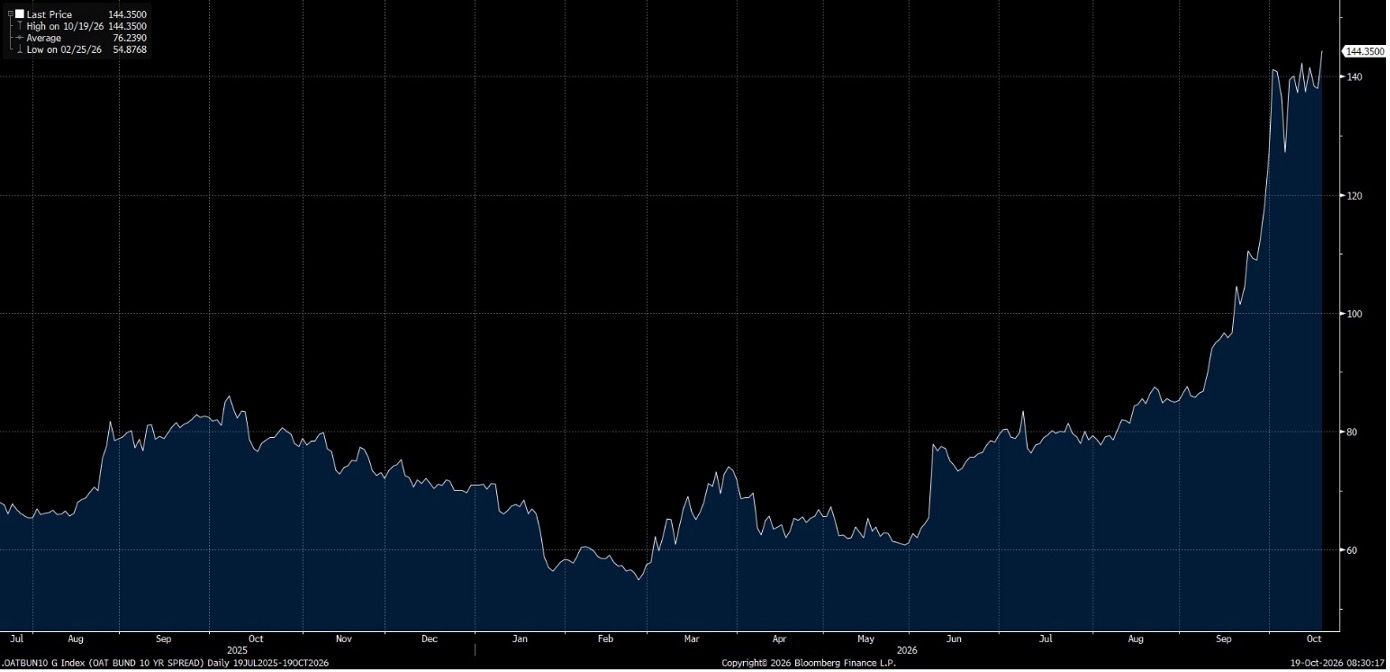
Stepping back from the day-to-day repricing to the structural story underneath it helps explain why this volatility has somewhere to live. Quantitative tightening has been steadily removing the least price-sensitive buyer from the government bond market, the central bank itself -leaving private investors to set the clearing price for 10-, 20-, and 30-year debt. That shift alone would have raised the term premium, since private capital demands more compensation for duration risk than a central bank balance sheet. Add a deteriorating fiscal picture in the US and- and more acutely-  in France, where debt-to-GDP stands at 119% (against a euro-area average of 87.8%) and no budget surplus has been run since 1974. Investors are increasingly pricing sovereigns on fiscal credibility rather than treating them as interchangeable. A single pledge to keep cutting the French deficit tightened 10-year OAT spreads by nearly 14 bps in one day earlier this quarter. Markets are watching the fiscal story closely, and they’re willing to reprice fast on any signal in eitherdirection.

An emergingpiece of that mechanism, characterized as a capital-competition story rather than a credit one, is AI-related debt issuance. Some market research reports have estimated hyperscaleAI debt issuance could approach $570bn in 2026, a volume large enough to compete directly with sovereigns for the same pool of duration-buying capital and to potentially push the neutral rate structurally higher.  With more issuance against the same buyer base, higher borrowing costs ensue..

Chart 2- French (OAT) – Germany (Bunds) 10Y yield spread

Source: Bloomberg

What’s New This Month

This month added something new to that mechanism: the AI capital-competition story which in our view is starting to look like a credit story . On October 15 and 16, CoreWeave’s five-year CDS spreads widened to a record level before partially retracing. Reports surfaced of a materially lower Anthropic IPO valuation target, and a widely circulated industry note flagged that more than $3.5 trillion of announced AI infrastructure spending could be exposed to impairment by the end of the decade. Those are balance-sheet headlines, not supply-and-demand ones, yet they moved the 10-year more in 48 hours than the hottest inflation print of the year did. The debt issuance volume is a published estimate; whether that issuance now carries real default risk, and whether that risk is driving part of the rates move remains to be seen. For clients with exposure to data center financing, private credit structures tied to hyperscaler capex, or infrastructure assets levered to the AI buildout, this is the theme to watch most closely into year-end.

Why the Term Premium Isn’t Going Away

None of this changes our underlying view that this year’s elevated long-end yields reflect a genuine repricing of the term premium, not a temporary overshoot. Quantitative tightening removing the price-insensitive buyer, persistent fiscal pressure in the US and France, and AI-related financing conditions, both as a capital-competition story and potentially now as a credit story, all point toward a structurally higher and more volatile term premium rather than a return to the low-rate-volatility regime of the past decade. Cheap post-crisis capital may not return soon. What this month showed is that the path to any given yield level is likely to stay far noisier than the destination itself.

What This Means for Positioning

For private capital clients, the practical implication is straightforward: consider hedging around capping how high financing costs can rise, not around predicting the next print or the next Fed speech. Rates volatility has been elevated and bidirectional, which argues for discipline around duration hedges rather than conviction bets on direction.A disciplined approach should also be applied towider tolerance bands on financing costs tied to AI-infrastructure-adjacent exposure, given how quickly sentiment in that sector has started to impact rates more broadly. Separately, the France-Germany spread has already started widening again, back to roughly 144 bps as of October 19 after easing into the 130s earlier this month, suggesting the repricing ahead of the Moody’s review on October 23 and the French budget vote on October 28 may already be underway rather than purely a forward risk.


Author

Jourdon Craig, Associate, Global Capital Markets Trading

By submitting this form you are agreeing to our Privacy Policy

Let’s talk.

Whether it’s about how Validus can protect your portfolio returns, streamline your fund finance operations, or bring your risk and financing data together in our Horizon platform – we’d like to hear from you.

90 Whitfield Street
5th Floor
London
W1T 4EZ

+44 203 923 8575