

The Real Yield Story: when will investors return to US treasuries?

Global Bonds: Yield Another Day

08 October 2026

Key Takeaways


  • Sovereign yields are rising for reasons that extend beyond inflation, with energy pressures, fiscal deterioration, quantitative tightening and AI investment all increasing competition for capital
  • AI infrastructure spending is creating a significant new source of bond supply and may also support higher real interest rates
  • Quantitative tightening is shifting price-setting power back to private investors, who now demand more compensation for duration, inflation uncertainty and fiscal risk
  • Borrowers should focus less on forecasting rates and more on setting an acceptable ceiling for financing costs

“My approach to bonds is pretty much like my approach to stocks. If I can’t understand something, I tend to forget it.” – Warren Buffett

Global bond markets are repricing sharply. Sovereign yields across developed economies have risen to multi-decade highs, increasing financing costs for governments, households and companies.

Inflation was the catalyst, but it does not fully explain the scale of the sell-off. Energy pressures, resilient growth, weaker fiscal positions, quantitative tightening and an exceptional wave of AI-related investment are all competing for a finite pool of capital.

The central question is how much compensation investors will demand to finance a more capital-hungry global economy, and what that means for borrowers approaching refinancing or reset dates.

Why sovereign bonds are selling off

Inflation set the move in train, while the energy shock linked to conflict in the Middle East has added pressure. Oil above $100 a barrel has pushed headline inflation higher, particularly in energy-import-dependent Europe – something discussed in our recent note: “Cold homes, hot spreads, hard choices: Europe’s winter”.

A new competitor for global capital is adding to the pressure: artificial intelligence.

The largest technology companies, historically able to fund investment from internal cash flows, are increasingly using debt to finance AI infrastructure. Morgan Stanley estimates global AI-related debt issuance could approach $570bn in 2026 as hyperscalers invest in data centres, semiconductors and computing capacity.

That creates direct competition for sovereign borrowers. When highly rated technology companies offer attractive yields over government bonds, governments must work harder for the marginal dollar, pound or euro. At the same time, public-sector refinancing needs are large and central banks are withdrawing demand through quantitative tightening.

AI may also affect rates through the real economy. The investment boom is supporting activity as central banks try to restrain demand. If AI ultimately raises productivity and prospective returns on capital, it could also support a higher neutral real interest rate.

The paradox is that a technology expected to raise productivity could also help keep the price of money structurally higher.

Quantitative tightening by the Bank of England, Bank of Japan and European Central Bank removes some of the least price-sensitive buyers from bond markets. Private investors are therefore demanding more compensation for duration, inflation and fiscal risk.
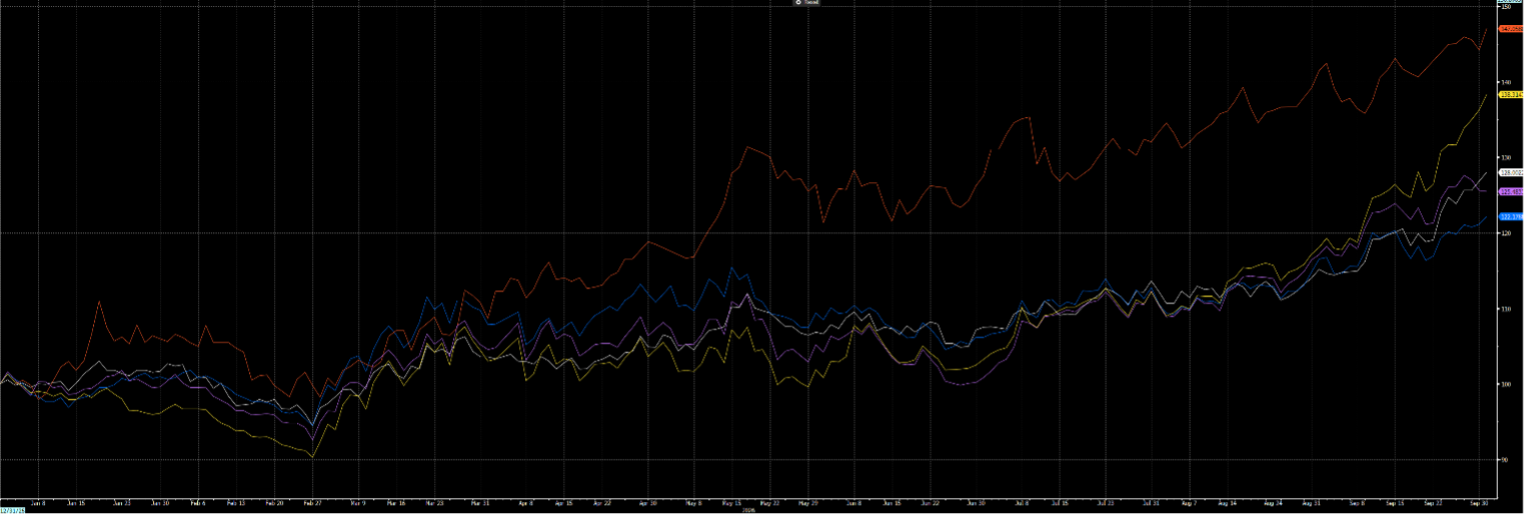
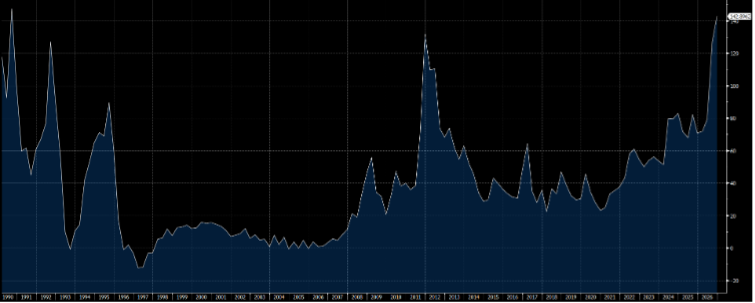
Chart 1: Nominal 10Y government bond yields – US, UK, Germany, France and Japan, normalized.

Source: Bloomberg, as of 2nd October 2026.

The repricing has been substantial. At the beginning of October, the 10-year US Treasury yield briefly reached 5.34%, its highest since 2002, after rising almost 90 basis points in the third quarter. The UK 30-year gilt yield moved above 6% for the first time since 1998, while 10-year borrowing costs reached their highest level since 2007.

The growing differentiation within Europe is equally important. French 10-year borrowing costs have approached 5%, while the spread over equivalent German Bunds has widened beyond 150 basis points. Rather than selling duration indiscriminately, investors are increasingly distinguishing between sovereigns on fiscal credibility.

France also plans to issue a record €340bn of medium- and long-term government debt in 2027, net of buybacks, compared with €310bn in 2026.

Global yields may be rising together, but fiscal credibility is increasingly determining the price each borrower pays.

Chart 2: OAT-Bund 10Y Spread

Source: Bloomberg, as of 2nd October 2026.

Central banks face a new constraint

Bond markets are increasingly tightening financial conditions on central banks’ behalf. Higher sovereign yields feed into mortgages, corporate funding and private-market discount rates, restraining investment and consumption even without another change in overnight policy rates.

The balance is delicate. Tighten too little and the energy shock could become embedded in underlying inflation. Tighten too aggressively while markets are already repricing duration and fiscal risk, and policy-led and market-led tightening could reinforce each other.

Why this regime is different

For much of the period after the global financial crisis, capital was abundant. Inflation was subdued, private investment was relatively weak and central banks absorbed large quantities of sovereign debt through quantitative easing, suppressing yields to near-zero or negative levels.

Today’s backdrop is close to the inverse: central banks are shrinking their balance sheets, governments face large borrowing and refinancing needs, and defense, energy infrastructure and AI are competing for capital.

This changes the identity of the marginal buyer. Under quantitative easing, central banks bought sovereign bonds for policy reasons and were relatively insensitive to price. Under quantitative tightening, governments must persuade private investors to absorb supply, and those investors require compensation for duration, inflation uncertainty and fiscal risk.

That helps explain the pressure at the long end of yield curves. Central banks influence short-term rates, but markets set the clearing price for 10-, 20- and 30-year government debt. Wider eurozone sovereign spreads and multi-decade highs in US and UK borrowing costs suggest investors are becoming more selective about the price at which they will hold duration.

The result may be a different fixed-income regime. Cheap post-crisis capital may not return soon. Investors are again being paid meaningfully to lend and can be more selective about whom they finance.

For borrowers, the practical implication is clear. Floating-rate exposure, refinancing risk and hedge maturity should be assessed together, not in isolation. When the path of rates is uncertain and the cost of being wrong is material, hedging is less about forecasting the next move than setting an acceptable ceiling for financing costs.

Author

Harry Woolman, Global Capital Markets Associate

By submitting this form you are agreeing to our Privacy Policy

Let’s talk.

Whether it’s about how Validus can protect your portfolio returns, streamline your fund finance operations, or bring your risk and financing data together in our Horizon platform – we’d like to hear from you.

90 Whitfield Street
5th Floor
London
W1T 4EZ

+44 203 923 8575