The BoE holds, but three dissenters and a warning from Bailey point to November
The European Central Bank conformed to market expectations last week and raised rates by a quarter point amid concerns that inflation will remain above target “for an extended period”. The Federal Reserve followed on Wednesday with its first increase in three years, taking its target range to 3.75–4.00%. With US-Iran tensions showing no signs of abating and energy prices continuing to rise sharply as a result, the topic of cost pressure was always going to be top of the Bank of England’s agenda. The question was whether the MPC would follow the path of the ECB or wait and review again at their next meeting on 5 November. On Thursday we got our answer: the Bank held Bank Rate at 3.75%, but by a narrower margin than the pre-meeting consensus implied. Three of the nine members – Greene, Mann and Chief Economist Pill – voted to move to 4.00%, and with August CPI at 3.1%, a five-month high, the debate has been deferred rather than settled.
Going into the meeting, market pricing suggested exactly that outcome, with the OIS curve attaching just a ~21% chance to a 0.25% hike this week while having one close to fully priced for November. The 6-3 split and the tone of the accompanying statement have kept that November move firmly in play: money markets now put the probability of a hike on 5 November at roughly 88% – a little softer than the near-certainty priced beforehand, but still comfortably the market’s base case. So, the question was never really ‘will they or won’t they [hike],’ but ‘when will they?’ – and that remains the question.
The decision to wait was, to our mind, the intuitive one despite the recent rise in energy prices. If a resolution could be reached between US and Iran (Trump would certainly welcome a boost with the US mid-terms coming up) energy prices could reverse as quickly as they’ve risen (think late May / June) which in turn would ease the pressure to tighten aggressively. Meanwhile, although recent UK data has shown the UK economy to be surprisingly resilient (GDP, labour market data, etc.) there are plenty of doubts over the accuracy of recent numbers supplied by the ONS and other indicators suggest that the UK economy will struggle with higher borrowing costs.
Bailey’s framing pointed the same way. Higher global energy costs have, in his words, “so far had only a limited effect on wider UK price and wage setting,” though “the longer the disruption continues, the greater the risk that inflation becomes embedded”. In practice, the Bank has bought itself seven weeks to establish whether this energy shock is a one-off level effect or the beginning of a second-round one – and told the market, fairly explicitly, which way it will lean if the answer is the latter.
The bigger story: the Bank’s QE endgame
Arguably the more consequential announcement came not on rates but on the balance sheet. The Bank halted sales of long-dated gilts altogether, paused gilt auctions until April 2027, and set out an eight-year path to run the stock down by 2034: broadly, some £120bn of 2049-and-beyond maturities retained permanently to back banknotes, £222bn held to maturity, and £146bn of 2035–2049 paper sold over time. That slows the annual unwind to around £46bn, roughly £20bn of outright sales plus £26bn of maturities. The long end responded accordingly, with 30-year gilt yields posting their largest single-day fall since April to reach three-week lows. For anyone hedging long-dated or floating-rate exposure, this is the part of Thursday’s announcement that moves the curve they actually pay on.
What does this mean for sterling?
Typically, higher rates are associated with a stronger currency, and it would have been intuitive to expect a hawkish hold to support sterling vs its peers. In the event, the pound did the opposite: GBPUSD slipped around 0.2% to the low 1.33s even as the statement flagged inflation “likely to rise further over coming quarters” and risks “tilted to the upside.” What proved more interesting than the decision itself was not simply what Governor Bailey said, but what he was saying it against. The Federal Reserve’s move to 3.75–4.00% on Wednesday – its first hike in three years, with markets attaching better-than-even odds to a further increase in October – restored a dollar rate advantage that a hawkish hold in London could not offset. The lesson is a familiar one: sterling is priced on relative policy, not absolute hawkishness.
Market indicators
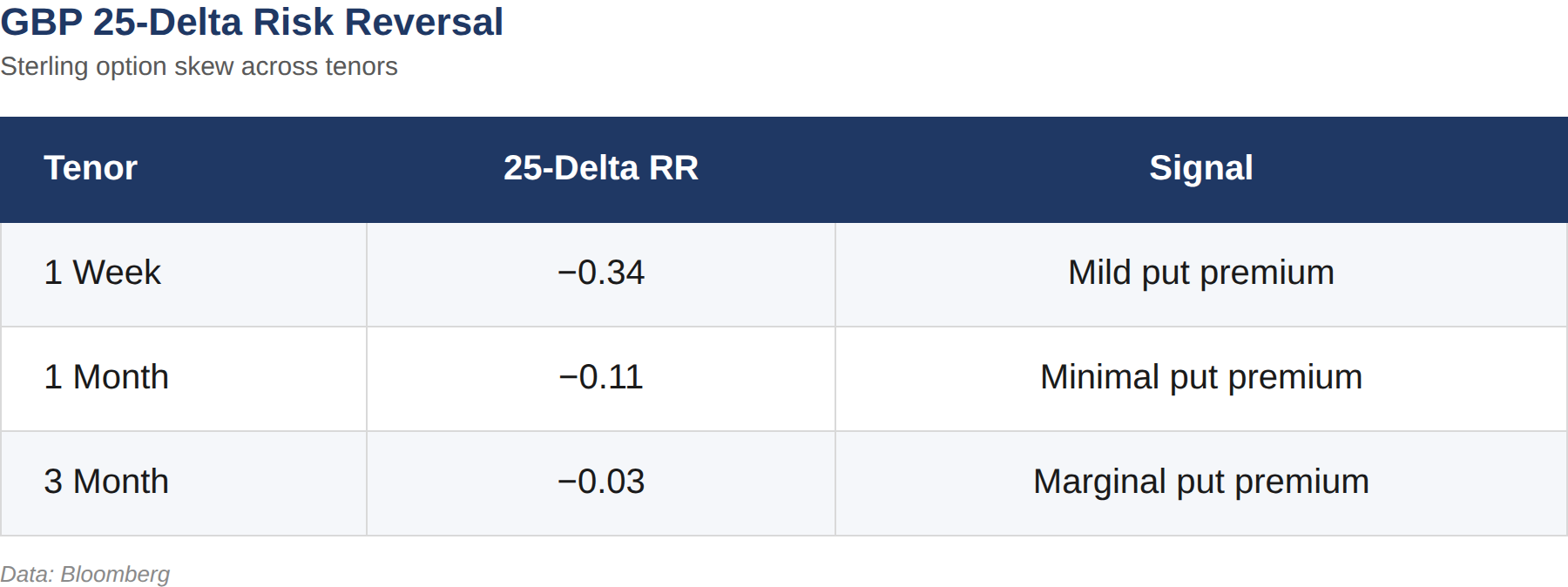
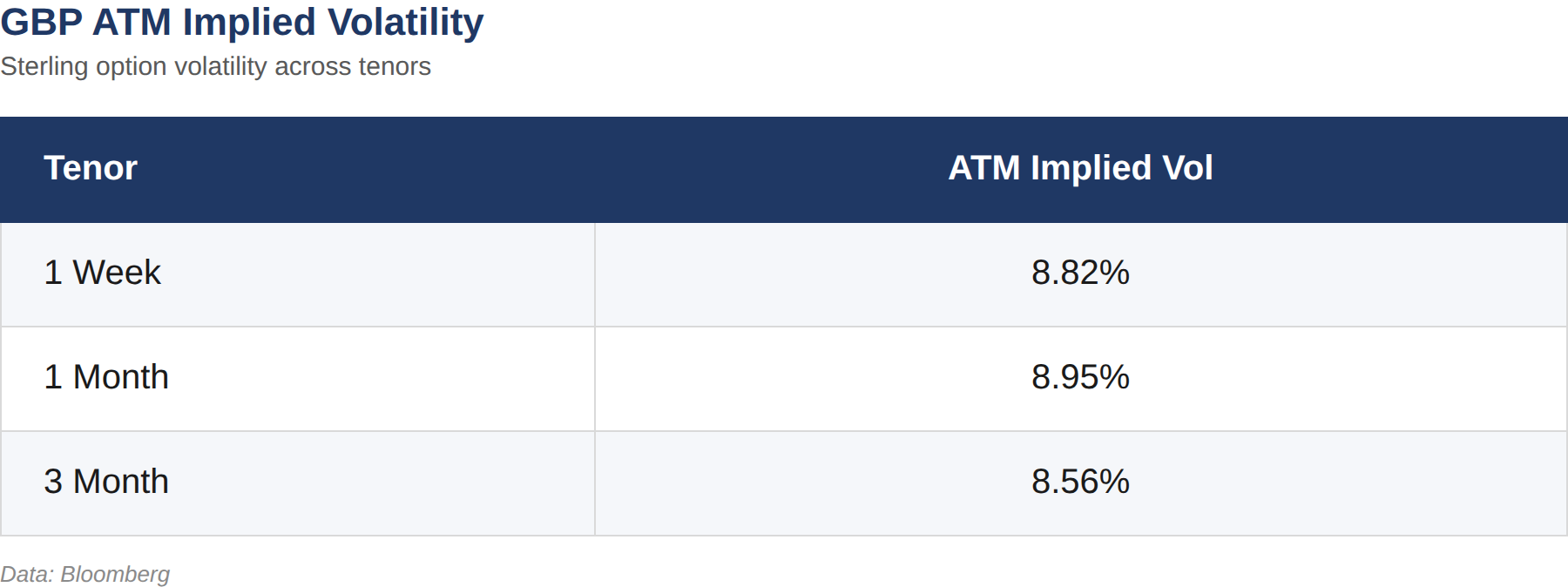
Ahead of the meeting, the GBPUSD option market suggested that traders were somewhat relaxed about downside risks for sterling. Whilst all three tenors below showed negative risk reversals, meaning the market was paying more for GBP puts (the right to sell sterling) than for equivalent GBP calls, the premium was marginal. Moreover, the skew became increasingly narrow the further out you looked, suggesting the market was acknowledging a slight risk premium over the week that captured the MPC meeting but beyond that, traders were more relaxed.