

To cut or not to cut (rates): Let’s flip a coin | News & Insights | Validus Risk Management

To cut or not to cut (rates): Let’s flip a coin

20 December 2023

Summary

“It would be premature … to speculate on when policy might ease” Chair Powell, Dec 1st

… to begin dialing back the amount of policy restraint in place, that begins to come into view, and is clearly a topic of discussion … for us at our meeting today.” Chair Powell, FOMC press conference, Dec 13th

We aren’t really talking about rate cuts right now” New York Fed President, Williams, Dec 15th

Having insisted that inflation was transitory while all the signs indicated otherwise before starting a tardy rate hiking cycle, it took Fed Chair Powell nearly two years of hawkish tone – and potentially some overshooting of the rate hikes – to try and re-establish some credibility for the Fed.

But it took less than hour for Powell, once again, to fatally bruise the Fed’s credibility by adopting a dovish tone – with talk of potential easing just two weeks after saying that it was vastly premature to even consider the conversation!

In all fairness, the markets had, since early October, already started to aggressively price rate cuts – incidentally sustaining a massive rally in equities – despite the Fed’s persistence on the “higher for longer” message, thus testing the Fed’s discourse and resolve.

In our view, the market had already done some of the job for the Fed going into the Dec 13th FOMC meeting (Chart 1). Traditionally in this kind of scenario, the rational approach – one taken many times past by pervious Fed Chairs – would be to slightly soften their hawkish tone and avoid being perceived as giving in to the market’s pressure, by pouring fuel on the fire.
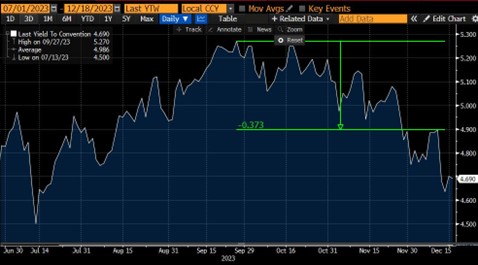
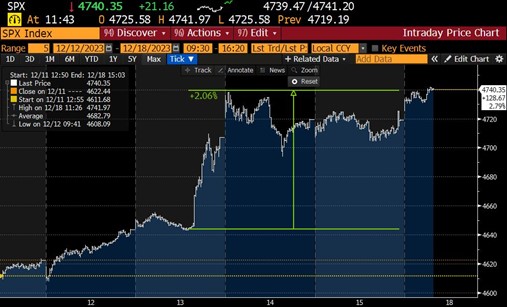
Chart 1: From early October markets progressively priced in nearly 2 rate cuts by end of July 2024

Source: Bloomberg

Powell’s less than ideal communication crowned the recent equity rally by an additional 2% and saw the markets price another one and a half rate cuts by July 2024, bringing the total to 75bps.

Interestingly, we had mentioned the possibility of this scenario in our December 2022 note, “Mirror of the Error”, when we noted that:

“… paradoxically, a fast drop in inflation numbers could be beneficial to risk assets because the market would price a pause in the hiking cycle, helping equity prices in an environment of a higher short and long-term rate. This in turn could be followed by a drop in rates as we enter a rate cut cycle – in the 12-18 months horizon – which would then be beneficial to fixed income assets, resulting in a positive upside correlation between equities and bonds and likely softening of the US dollar, somewhat mirroring what we saw in 2022 which was the positive correlation of equities and bonds in a sell-off which challenged the classic 60/40 portfolio.”

Chart 2: The Powell effect fueling an extra rally in risk assets as rate cut expectations rose

Source: Bloomberg

Where to now?

Here are a few thoughts as to what might be ahead of us in the weeks and months to come, in light of market price action since early October and last week’s Fed meeting:

  • First, a lot of “good news”, i.e. rate cuts, is now priced in. While markets could price further cuts, that would likely happen under of two scenarios or a combination of both:
    1. A weakening of measures of inflation and/or economic growth statistics.
    2. A flare-up and/or crisis as a result of geopolitical tensions – in particular in the Middle East if they were to expand, and to a lesser extent in the Ukraine/Russia conflict.
  1. While rate cuts are good news, they are only so up to a point. If further rate cuts are priced to counter a potential important economic slowdown, then the run-up in equities could pause or revert. Albeit, in that scenario, fixed income assets will continue their rally.
  2. In fact, US long-term real rates have likely peaked – the 10-year US real rate now sits at 1.72% down from 2.5% in early November and will help provide some stability to the long-end of the curve whether equities continue their rally or not.
  3. In our view, it is quite likely that commodity prices – in particular soft commodities and grains – will find a support level and not necessarily keep falling like pervious cycles of lower inflation. Why? This is particularly due to capped supply (climate and other effects) versus consumption growth (population and replacement).
  4. It is also important to remember that monetary policy regime changes often result in important changes as they are the drivers of major asset and risk reallocations, by institutions and investors alike. For instance:
    1. Growth and mid/small caps are usually favored. So far, the Russell 2000 has outperformed the S&P500 by nearly 8% since early November.
    2. A sea change of sector rotations under the surface as some interest rate-sensitive sectors come to life (e.g., financials) and other sectors reflect an economic slowdown (e.g., industrials).

    The Fed’s less than optimal communication will likely continue and bring further uncertainty and, as a result, a sudden change in expectations in both directions as we go down the path of a new and less restrictive monetary policy cycle, wrong footing investors many times more.

    auto [rcblock id=”78″] center auto 20px 0 20px 0 [contact-form-7 id=”73″ title=”First to know”] center auto 20px 0 20px 0

Author

Kambiz Kazemi, Chief Investment Officer